Cloud adoption has become a foundational step for modern enterprises, but moving to the cloud does not automatically guarantee agility, scalability, or cost efficiency. As organizations evaluate their Cloud Strategy, it becomes clear that success depends not just on adopting cloud platforms, but on how the migration approach is defined and executed. While a vast majority of businesses rely on the cloud today, the outcomes of their journeys vary significantly—driven largely by the strategy chosen.
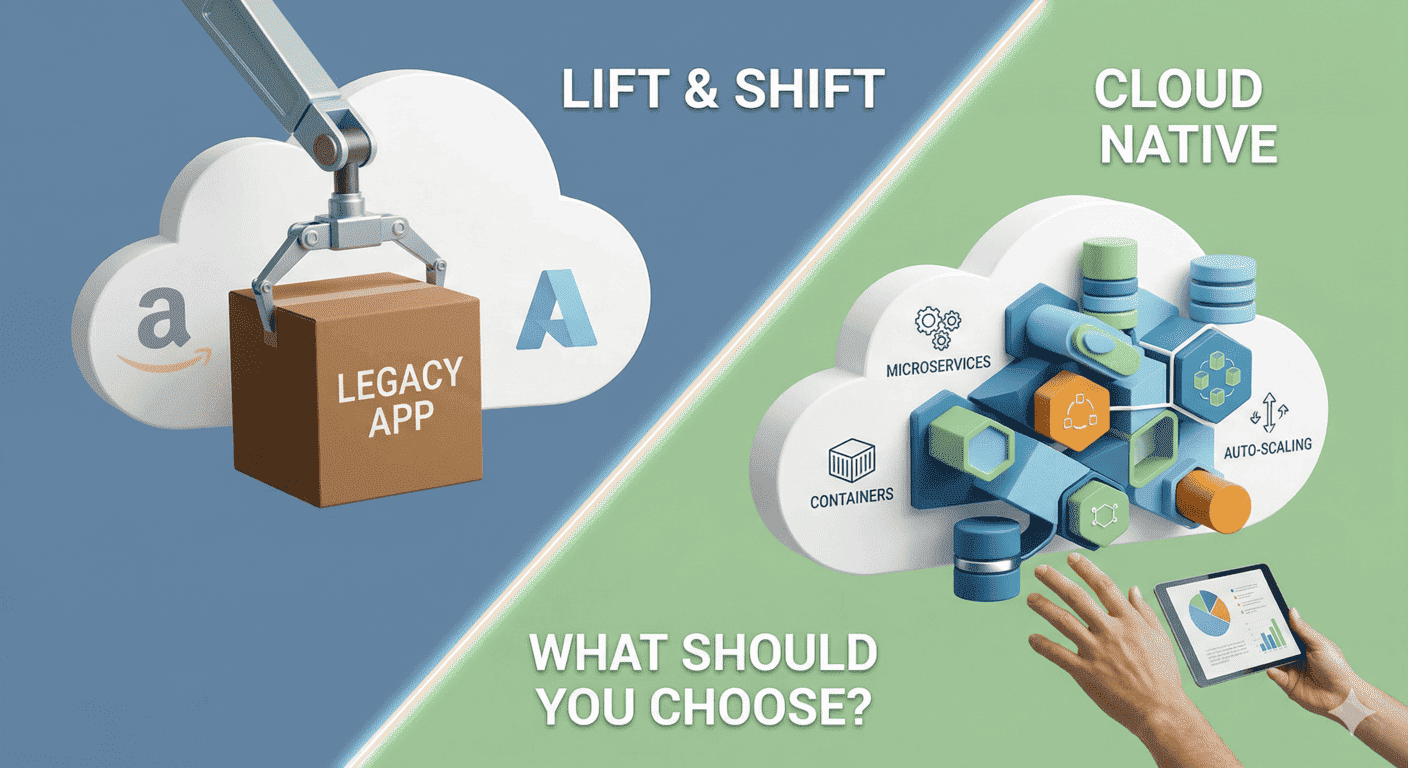
At the core of this decision is the comparison of Cloud-Native vs Lift-and-Shift approaches. When organizations begin shaping their Cloud Strategy, these two models emerge as the primary options. While both serve distinct purposes, they represent fundamentally different philosophies in how systems are designed, modernized, and scaled to meet evolving business demands.
Lift-and-Shift: Speed Over Transformation
Lift-and-shift, or rehosting, is often the first step organizations take toward the cloud. It involves moving applications from on-premises environments to the cloud with minimal or no changes to the underlying architecture. This approach prioritizes speed and simplicity, allowing businesses to quickly exit legacy infrastructure without disrupting existing functionality.
The appeal of lift-and-shift lies in its low barrier to entry. It enables faster migrations, avoids the need for extensive redesign, and reduces immediate infrastructure overhead. For organizations under pressure—whether due to data center exits, hardware constraints, or urgent modernization mandates—it provides a practical and low-risk starting point.
However, this convenience comes with trade-offs. Applications that were never designed for the cloud often carry their limitations with them. Instead of eliminating inefficiencies, lift-and-shift simply relocates them. Over time, this can lead to higher operational costs, limited scalability, and underutilization of cloud capabilities. What appears efficient in the short term can restrict innovation in the long run.
Cloud-Native: Designed for the Cloud from Day One
Cloud-native modernization takes a fundamentally different approach. Instead of moving applications as-is, it rethinks how they are built and operated. Applications are designed to fully leverage cloud capabilities—scalability, resilience, automation, and continuous delivery.
This approach typically involves breaking monolithic systems into smaller, independent services, leveraging containers, orchestration platforms, and serverless models. The result is an architecture that can scale dynamically, evolve rapidly, and adapt to changing business needs without impacting the entire system.
Cloud-native systems enable faster innovation cycles. Teams can deploy changes independently, experiment more freely, and respond to market demands with greater agility. Operational efficiency improves as resources are consumed on demand, and systems are designed to recover gracefully from failures.
That said, cloud-native is not a quick win. It requires upfront investment—in time, talent, and technology. Teams must adopt new ways of working, embrace DevOps practices, and build expertise in modern engineering paradigms. Security and governance also become more complex in distributed environments, requiring a more proactive and integrated approach.
Strategy Before Technology: Making the Right Choice
The decision between lift-and-shift and cloud-native should not be driven by technology trends alone. It should be grounded in business context, application value, and long-term goals.
Applications that are core to business operations, require frequent updates, or demand scalability are strong candidates for cloud-native transformation. These systems benefit the most from flexibility, resilience, and continuous innovation.
On the other hand, applications with stable usage patterns, limited future relevance, or nearing end-of-life are better suited for lift-and-shift. In such cases, the goal is not transformation but optimization—reducing infrastructure burden without overinvesting in modernization.
Time and budget also play a critical role. When timelines are tight, lift-and-shift offers a fast and effective path to the cloud. But for organizations focused on long-term value and total cost optimization, investing in cloud-native capabilities often delivers significantly higher returns over time.
Equally important is organizational readiness. Cloud-native requires a shift in mindset—from managing infrastructure to engineering platforms. Without the right skills and operating model, the benefits of cloud-native can be difficult to realize. In such scenarios, a phased approach—starting with lift-and-shift and gradually modernizing—often proves more practical.
The Bottom Line: Evolution, Not a Binary Choice
Framing cloud strategy as a choice between lift-and-shift and cloud-native can be misleading. In reality, the most effective cloud journeys are not binary—they are evolutionary.
Lift-and-shift can serve as an entry point, enabling quick wins and immediate cost reduction. Cloud-native, on the other hand, represents the destination—where systems are optimized for scale, resilience, and continuous innovation.
The key is to align each application with the right approach, based on its business value and future relevance. By doing so, organizations can build a balanced roadmap—one that delivers short-term impact while steadily moving toward a more modern, scalable, and future-ready architecture.
Ultimately, the cloud is not just a place to host applications. It is a platform to reimagine how systems are built, operated, and evolved. The organizations that succeed are those that treat it not as a migration exercise, but as an opportunity to transform.