The Future of Customer Experience Is Intelligent
For years, customer portals have served as digital gateways for organizations to provide information, support self-service transactions, and streamline customer interactions. While these portals have helped businesses improve accessibility and reduce operational costs, customer expectations have evolved significantly.
Today’s customers expect more than a static portal filled with documents, forms, and navigation menus. They expect experiences that are personalized, conversational, and capable of delivering answers instantly. They want systems that understand their intent, guide them through complex processes, and proactively recommend the next best action.
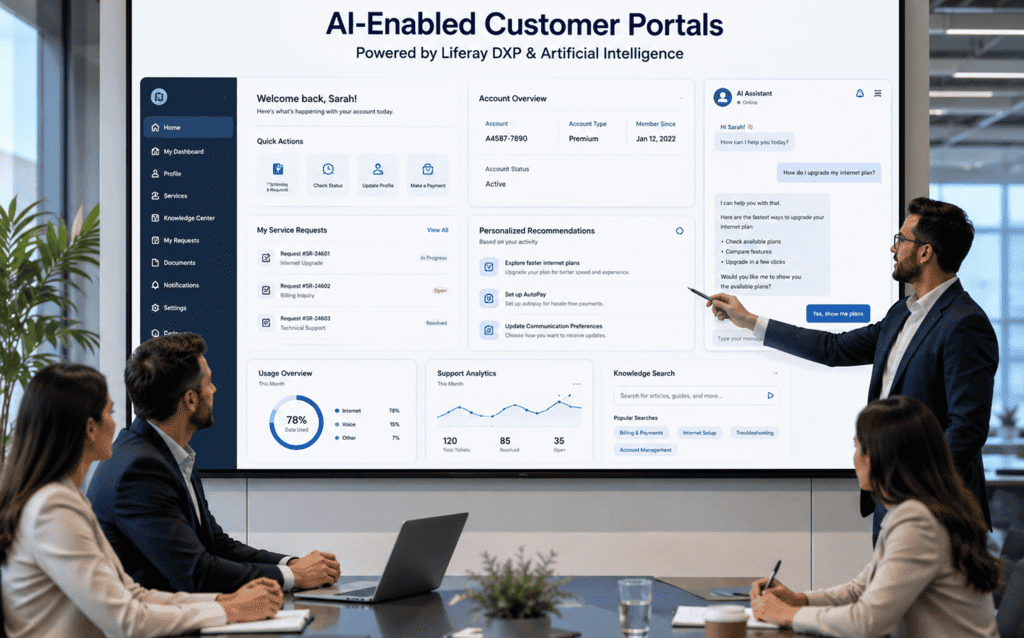
As Artificial Intelligence continues to reshape how organizations engage with customers, traditional self-service portals are evolving into intelligent digital experience platforms. By combining the power of AI with the flexibility and enterprise capabilities of Liferay DXP, organizations can create customer portals that not only provide information but actively assist users in achieving their goals.
The result is a smarter, more engaging, and more efficient customer experience that benefits both customers and the organizations serving them.
Why Traditional Customer Portals Are No Longer Enough
Many organizations invested heavily in customer portals over the past decade. These platforms successfully digitized forms, centralized content, and enabled online transactions. However, many of these portals still operate using a traditional “search and navigate” model.
The challenge is that customers often know what they want to accomplish but do not know where to find the information required to complete the task.
A customer looking to submit a claim, update account information, understand policy coverage, or troubleshoot an issue may need to navigate through multiple pages, documents, and knowledge articles before finding the right answer. Common frustrations include:
- Difficulty locating relevant information
- Generic search results with little context
- Complex customer journeys requiring multiple steps
- Long wait times for support assistance
- Limited personalization
- Repetitive manual service requests
As customer expectations continue to rise, organizations must move beyond static self-service experiences and deliver intelligent, context-aware interactions that reduce effort and improve outcomes.
What Makes a Customer Portal AI-Enabled?
An AI-enabled customer portal combines traditional portal capabilities with intelligent technologies that can understand user intent, retrieve relevant information, automate tasks, and personalize experiences.
Rather than forcing users to navigate through complex site structures, AI enables customers to interact naturally using conversational interfaces and intelligent recommendations.
An AI-enabled portal typically includes several key capabilities.
Intelligent Search and Knowledge Discovery
Traditional keyword-based search often returns large volumes of content that customers must manually filter and review.
AI-powered search transforms this experience by understanding context, intent, and natural language questions.
Instead of searching for:
“Benefits claim submission process”
A customer can simply ask:
“How do I submit a dental claim for my dependent?”
The system can interpret the request, identify relevant content, and provide a direct answer or guide the user through the process.
AI Assistants and Virtual Agents
Embedded AI assistants can act as a first point of contact within the portal, providing immediate support and guidance. These assistants can help users:
- Navigate the portal
- Answer frequently asked questions
- Explain policies and procedures
- Locate documents
- Initiate service requests
- Escalate complex issues to support teams
Unlike traditional chatbots that rely on predefined decision trees, modern AI assistants can understand conversational context and deliver more natural interactions.
Personalized Digital Experiences
Every customer has unique needs, preferences, and engagement patterns. AI enables organizations to deliver personalized experiences based on:
- Customer profiles
- Account information
- Previous interactions
- Service history
- Behavioral insights
This allows portals to surface the most relevant content, services, and recommendations for each user rather than presenting the same experience to everyone.
Intelligent Process Assistance
Many customer interactions involve completing forms, submitting requests, or following multi-step processes. AI can simplify these experiences by:
- Guiding users through workflows
- Pre-populating information
- Recommending next steps
- Validating data before submission
- Providing contextual assistance
Why Liferay DXP Is an Ideal Foundation for AI-Powered Portals
While AI receives much of the attention, the success of an AI-enabled customer portal depends heavily on the underlying digital experience platform. Organizations need a platform capable of managing content, users, workflows, integrations, and governance at enterprise scale.
This is where Liferay DXP provides significant value.
Unified Digital Experience Platform
Liferay DXP combines multiple capabilities within a single platform, including:
- Content management
- User and identity management
- Personalization
- Workflow automation
- Search and discovery
- API and integration capabilities
This unified approach provides the foundation required to build intelligent customer experiences without creating disconnected technology silos.
Enterprise Integration Capabilities
AI is only valuable when it has access to trusted business information. Most customer interactions require data from multiple enterprise systems such as:
- CRM platforms
- ERP systems
- Customer databases
- Knowledge repositories
- Document management systems
- Service management applications
Liferay’s integration framework enables organizations to connect these systems and create a centralized experience layer where AI can access and utilize enterprise knowledge effectively.
Security, Governance, and Compliance
As organizations introduce AI into customer-facing experiences, governance becomes increasingly important. Liferay provides enterprise-grade capabilities including:
- Role-based access control
- Content permissions
- User authentication and authorization
- Audit trails
- Secure API integrations
- Compliance support
These capabilities help organizations maintain control over information access while delivering AI-powered experiences securely and responsibly.
High-Impact AI Use Cases for Liferay Customer Portals
Organizations across industries are already exploring practical ways to introduce AI into customer experiences. Some of the most impactful use cases include:
AI-Powered Knowledge Assistants
Knowledge assistants can provide instant answers to customer questions by leveraging organizational content and documentation. Instead of searching through multiple articles, users receive direct responses grounded in approved enterprise content. Benefits include:
- Faster issue resolution
- Reduced support volumes
- Improved customer satisfaction
- Better knowledge utilization
Intelligent Case and Request Management
AI can help customers create, track, and manage service requests more efficiently. Customers can describe their issue in natural language, and the system can automatically categorize requests, recommend actions, and guide them through resolution processes.
Personalized Customer Journeys
AI can analyze customer behavior and recommend relevant content, services, and actions. Examples include:
- Suggested products or services
- Recommended knowledge articles
- Personalized dashboards
- Contextual notifications
- Targeted communications
This creates more relevant and engaging customer experiences.
Document and Policy Assistance
Many organizations maintain extensive libraries of policies, procedures, agreements, and regulatory documents. AI can help customers interact with this information conversationally by answering questions and retrieving relevant sections of documentation.
When combined with Retrieval-Augmented Generation (RAG), responses can be grounded in approved enterprise content, improving accuracy and trust.
Multilingual Customer Support
Organizations serving diverse customer bases can use AI to improve accessibility and engagement across multiple languages. Capabilities may include:
- Real-time translation
- Multilingual knowledge retrieval
- AI-assisted customer conversations
- Localized content recommendations
This helps organizations deliver consistent customer experiences globally.
A Reference Architecture for AI-Enabled Customer Portals
Building an AI-enabled portal requires more than simply integrating a large language model. Successful implementations rely on a well-structured architecture that balances experience, intelligence, governance, and security. A typical architecture includes:
Experience Layer
Powered by Liferay DXP, this layer delivers:
- Customer-facing portal experiences
- Personalized dashboards
- Content delivery
- User interactions
AI Layer
Provides intelligent capabilities such as:
- AI assistants
- Conversational interfaces
- Recommendation engines
- Generative AI services
Knowledge Layer
Acts as the trusted source of information and may include:
- Content repositories
- Knowledge bases
- Policy documents
- Enterprise content libraries
Integration Layer
Connects AI and portal experiences with backend systems including:
- CRM platforms
- ERP systems
- Customer databases
- Service applications
Governance and Security Layer
Ensures responsible AI adoption through:
- Access controls
- Data governance
- Monitoring
- Compliance controls
- Auditability
Organizations that establish these foundational layers early are significantly more successful in scaling AI initiatives over time.
Key Considerations Before Introducing AI
While the opportunities are compelling, successful AI adoption requires careful planning.
Data Readiness
AI systems depend on accurate, structured, and accessible information. Poor-quality data often leads to poor-quality outcomes. Organizations should evaluate their content, knowledge repositories, and enterprise systems before introducing AI capabilities.
Content Governance
AI responses are only as reliable as the content they access. Establishing clear ownership, review processes, and content lifecycle management is essential.
Security and Privacy
Organizations must ensure that customer information remains protected and that AI solutions align with regulatory and compliance requirements.
User Experience Design
AI should simplify experiences rather than introduce complexity. The best AI-enabled portals make interactions feel natural while keeping users in control of the customer journey.
The Business Benefits of AI-Enabled Customer Portals
Organizations investing in AI-powered customer experiences are seeing benefits across multiple dimensions.
Improved Customer Satisfaction – Customers receive faster, more relevant answers with less effort.
Reduced Support Costs – AI can automate routine inquiries and reduce support ticket volumes.
Increased Portal Adoption – Better experiences encourage customers to engage through digital channels.
Operational Efficiency – Automated workflows reduce manual effort and accelerate service delivery.
Better Business Insights – AI-generated insights help organizations understand customer behavior, identify trends, and improve service offerings.
How Solveloop Helps Organizations Build AI-Powered Digital Experiences
At Solveloop, we believe successful AI initiatives require more than technology implementation. They require a clear strategy, a scalable architecture, and a deep understanding of customer experience design. Our approach combines expertise across:
- AI Strategy & Transformation
- Generative AI & Intelligent Applications
- Liferay Architecture Services
- Digital Experience Modernization
- Enterprise Integration
- Intelligent Automation
By bringing together AI capabilities and modern digital experience platforms, we help organizations create customer portals that are intelligent, scalable, secure, and aligned with long-term business objectives.
Conclusion
Customer portals are rapidly evolving from information repositories into intelligent digital experience platforms. Organizations that embrace AI have an opportunity to transform customer interactions by delivering faster answers, personalized experiences, and more efficient service delivery. However, achieving these outcomes requires a strong foundation that combines enterprise-grade digital experiences, trusted business data, and responsible AI implementation.
Liferay DXP provides that foundation.
When paired with thoughtfully designed AI capabilities, it enables organizations to build customer portals that do more than serve information they understand customer needs, guide users toward outcomes, and continuously improve the overall experience.
The future of customer portals is not simply self-service. It is intelligent service, powered by AI and built on platforms designed for long-term digital transformation.