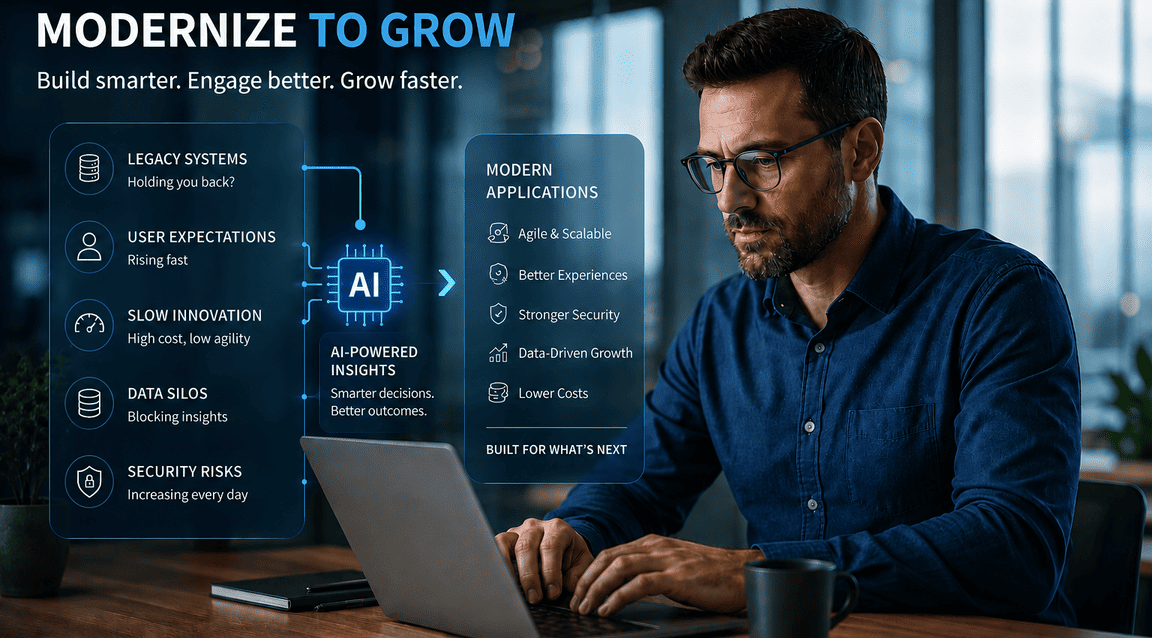
Technology is evolving faster than ever, yet many organizations continue to rely on applications built years—or even decades—ago. While these systems may still function, they often create barriers to innovation, limit business agility, and increase operational risk.
Application modernization is no longer simply about replacing legacy technology. It is about creating a scalable digital foundation that supports growth, improves customer experiences, enables AI adoption, and reduces the long-term cost of maintaining outdated systems.
If you’re unsure whether modernization should be a priority for your organization, here are ten warning signs to watch for.
1. Your Applications Are Becoming Expensive to Maintain
When a significant portion of your IT budget is spent maintaining existing systems rather than creating new value, modernization should be on the agenda. Common indicators include:
- Increasing support and maintenance costs
- Dependence on specialized legacy skills
- Frequent production issues and outages
- Growing technical debt
Modern architectures, cloud-native platforms, and automated deployment processes can significantly reduce operational overhead while improving system reliability.
2. New Features Take Too Long to Deliver
Business requirements evolve quickly, and customers expect continuous improvement. If every enhancement requires months of planning, development, and testing, your technology stack may be slowing innovation. Organizations with modern application architectures can:
- Release features more frequently
- Respond to market demands faster
- Reduce deployment risks
- Improve collaboration between business and technology teams
Agility is increasingly becoming a competitive advantage, and legacy applications often stand in the way.
3. Integration Challenges Are Holding You Back
Today’s digital ecosystems rely on seamless connectivity between platforms, applications, and data sources. If your systems struggle to integrate with:
- CRM platforms
- ERP systems
- Marketing automation tools
- Customer portals
- AI services and analytics platforms
then modernization can help establish a more connected and scalable architecture through APIs and integration-first design.
4. User Experience Feels Outdated
Modern users expect intuitive, responsive, and personalized digital experiences across every channel. Signs of an outdated user experience include:
- Poor mobile usability
- Complex navigation
- Slow page performance
- Inconsistent user journeys
- Low adoption rates
Modern digital experience platforms such as Liferay DXP enable organizations to deliver personalized, self-service experiences while integrating seamlessly with existing business systems.
Improving user experience is often one of the quickest ways to increase customer satisfaction and employee productivity.
5. Security and Compliance Risks Are Increasing
Legacy applications frequently rely on outdated frameworks, unsupported libraries, and aging infrastructure. This creates challenges such as:
- Increased vulnerability exposure
- Difficulty meeting compliance requirements
- Limited visibility into security events
- Higher audit and remediation costs
Modern platforms provide stronger security controls, automated monitoring, identity management capabilities, and improved governance practices that help reduce organizational risk.
6. Infrastructure Costs Continue to Grow
Maintaining aging infrastructure can become increasingly expensive over time. Organizations often encounter:
- Underutilized servers
- High maintenance costs
- Capacity planning challenges
- Limited scalability
Modernizing applications and moving toward cloud-native architectures can provide greater flexibility, improved performance, and more predictable operational costs.
Cloud modernization also enables organizations to scale resources based on actual business demand rather than fixed infrastructure investments.
7. Your Teams Spend More Time Maintaining Than Innovating
When development teams are constantly focused on bug fixes, support tickets, and infrastructure issues, innovation slows down. This often results in:
- Delayed projects
- Reduced employee satisfaction
- Slower product development
- Missed business opportunities
Application modernization allows teams to focus on strategic initiatives rather than routine maintenance activities.
The result is greater innovation capacity and faster delivery of business value.
8. Your Applications Struggle to Scale
Growth is a positive challenge—but only if your technology can support it. Common scalability issues include:
- Performance bottlenecks
- Slow response times
- Availability concerns
- Increasing infrastructure complexity
Modern architectures are designed to support growth through scalable services, automation, containerization, and cloud-native deployment models.
Organizations that modernize their applications are better positioned to support future expansion without significant rework.
9. AI Initiatives Are Difficult to Implement
Artificial Intelligence is rapidly becoming a strategic priority for organizations across industries. However, many AI initiatives fail to gain traction because legacy systems were never designed to support them. Challenges often include:
- Limited API capabilities
- Poor data accessibility
- Fragmented systems
- Inconsistent data quality
- Complex integration requirements
Modernization creates the foundation required for successful AI adoption.
How AI Can Accelerate Modernization
AI is not only a driver for modernization—it can also help accelerate the modernization process itself. Organizations are increasingly using AI to:
- Analyze legacy codebases
- Generate technical documentation
- Assist with code refactoring
- Improve testing coverage
- Accelerate migration activities
- Reduce knowledge transfer risks
By combining modernization initiatives with AI capabilities, organizations can reduce delivery timelines and unlock additional business value.
10. Technology Is Limiting Business Strategy
Perhaps the strongest indicator of all is when technology becomes a constraint rather than an enabler. If your organization struggles to:
- Launch new digital services
- Improve customer experiences
- Expand into new markets
- Adopt emerging technologies
- Support business growth initiatives
then your application landscape may be preventing strategic progress.
Technology should support business objectives—not restrict them.
Application Modernization Is a Business Transformation Initiative
Application modernization is no longer simply an IT upgrade project. It is a strategic investment that enables organizations to improve agility, reduce risk, enhance customer experiences, and prepare for future innovation.
Whether your goal is cloud adoption, digital transformation, AI enablement, or modern digital experiences, modernization provides the foundation needed to achieve those objectives.
Organizations that act early are better positioned to adapt, innovate, and compete in an increasingly digital world.
The question is no longer whether modernization is necessary—but whether your organization can afford to delay it.