Artificial Intelligence has quickly moved from a future technology to a business necessity. From customer service automation and content generation to operational efficiency and predictive insights, AI is creating opportunities for organizations of every size, but success requires a clear AI Strategy & Transformation roadmap.
Yet many small and medium-sized businesses (SMBs) struggle with one critical question:
Where do we actually start?
The challenge isn’t a lack of AI tools. It’s the overwhelming number of options available and the uncertainty around which investments will deliver meaningful business value.
Many organizations rush into AI adoption only to discover that expensive software subscriptions, disconnected pilots, and unrealistic expectations lead to disappointing outcomes.
The good news is that successful AI adoption doesn’t require massive budgets or large data science teams. It requires a clear strategy, focused objectives, and a practical roadmap.
In this article, we’ll explore how SMBs can begin their AI journey and avoid some of the most common and costly mistakes.
Why SMBs Need an AI Strategy Before Buying AI Tools
One of the biggest misconceptions about AI is that success starts with selecting a platform.
In reality, technology should be the final step—not the first.
Organizations often purchase AI solutions because competitors are doing it or because a vendor promises dramatic productivity improvements. Without a clear understanding of business goals, these initiatives frequently fail to deliver measurable results. An effective AI strategy should answer questions such as:
- What business problems are we trying to solve?
- Which processes consume the most time and resources?
- Where are employees performing repetitive tasks?
- Which customer interactions could be improved?
- What data is available to support AI initiatives?
The answers to these questions create a foundation for identifying AI opportunities that align with business priorities.
Common AI Adoption Mistakes SMBs Should Avoid
Mistake #1: Chasing Technology Trends
Many organizations start with the latest AI platform rather than a business problem.
The result is often a proof-of-concept that looks impressive but delivers little operational value. Instead, focus on solving real business challenges such as:
- Customer support response times
- Manual document processing
- Content creation bottlenecks
- Employee onboarding inefficiencies
- Data entry and reporting tasks
When AI is tied directly to business outcomes, adoption becomes significantly easier.
Mistake #2: Trying to Automate Everything at Once
AI transformation is not an all-or-nothing initiative.
Attempting to automate multiple departments simultaneously often creates unnecessary complexity and resistance. A better approach is to start with one or two high-impact use cases where:
- Results can be measured quickly
- Risk is relatively low
- Business stakeholders are engaged
- Existing processes are already documented
Small wins build confidence and create momentum for larger initiatives.
Mistake #3: Ignoring Data Quality
AI systems are only as effective as the information they receive. Organizations frequently underestimate the importance of:
- Data accuracy
- Data consistency
- Process documentation
- Content governance
Before implementing AI solutions, evaluate whether the underlying business data is reliable and accessible.
Poor-quality data often becomes the hidden reason why AI initiatives fail to produce expected results.
Mistake #4: Expecting Immediate ROI
AI is a strategic capability rather than a one-time project. While some use cases can generate value quickly, sustainable results require:
- Process refinement
- User adoption
- Training
- Governance
- Continuous improvement
Organizations that view AI as a journey rather than a quick fix tend to achieve better long-term outcomes.
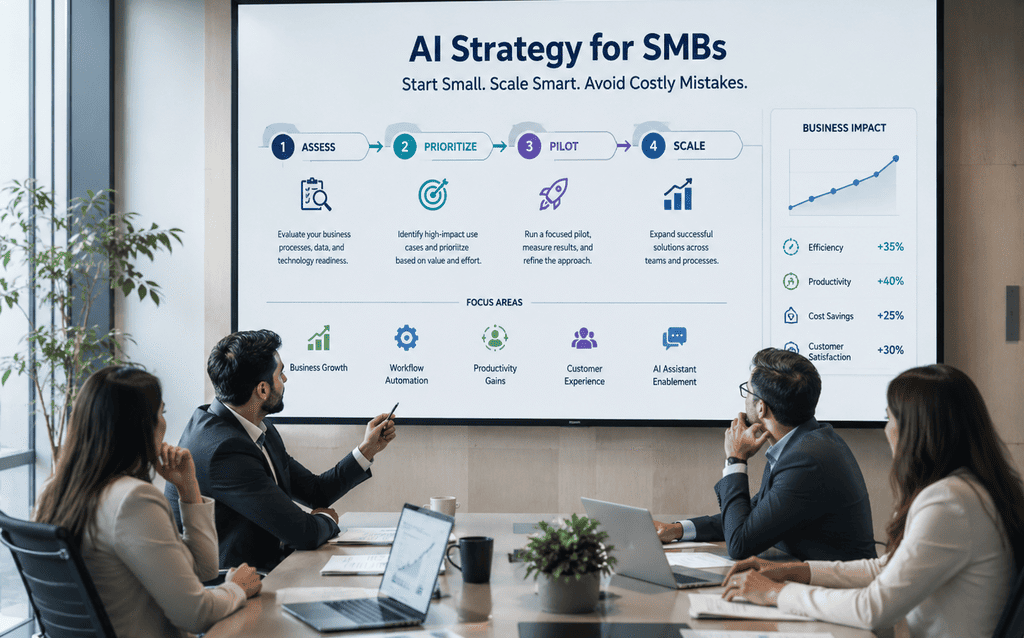
A Practical AI Adoption Framework for SMBs
Successful AI adoption often follows a simple four-step approach.
1. Assess Current Operations
Start by identifying:
- Manual workflows
- Process bottlenecks
- Customer experience challenges
- Repetitive administrative tasks
The goal is to uncover opportunities where AI can deliver measurable business impact.
2. Prioritize High-Value Use Cases
Not every AI opportunity deserves immediate investment. Evaluate initiatives based on:
- Business value
- Implementation effort
- Risk level
- Expected ROI
Focus first on projects that can deliver visible results within 60–90 days.
3. Pilot and Validate
Launch a controlled pilot before committing to broader deployment. Examples include:
- AI-powered customer support assistants
- Internal knowledge chatbots
- Automated content generation
- Intelligent document processing
- Workflow automation
Measure outcomes against predefined success criteria.
4. Scale Strategically
Once a pilot proves successful, expand gradually across departments and processes.
This reduces risk while maximizing organizational learning and adoption.
High-Impact AI Opportunities for SMBs
Organizations do not need advanced machine learning teams to benefit from AI. Some of the most practical use cases include:
Customer Service Automation
AI assistants can provide faster responses, reduce support workload, and improve customer satisfaction.
Intelligent Content Creation
Generate marketing content, product descriptions, email campaigns, and knowledge base articles more efficiently.
Workflow Automation
Automate repetitive processes such as approvals, document routing, and data entry.
Employee Productivity Assistants
Provide employees with AI-powered access to organizational knowledge and information.
Digital Experience Personalization
Organizations using platforms such as Liferay DXP can leverage AI capabilities to deliver more personalized customer experiences and improve content relevance across digital channels.
Conclusion
AI offers tremendous opportunities for SMBs, but success rarely comes from purchasing the latest tool and hoping for the best.
Organizations that begin with a clear strategy, modernize critical business processes, and adopt AI incrementally are more likely to achieve sustainable results. Whether your focus is AI Strategy & Transformation, Generative AI & Intelligent Applications, Intelligent Automation & AI Integration, or broader Digital Transformation, a structured roadmap helps maximize business value while minimizing risk.
The question is no longer whether SMBs should adopt AI.
The real question is:
How can your organization adopt AI in a way that creates sustainable business value while avoiding unnecessary risk and cost?
A thoughtful AI strategy provides the answer.