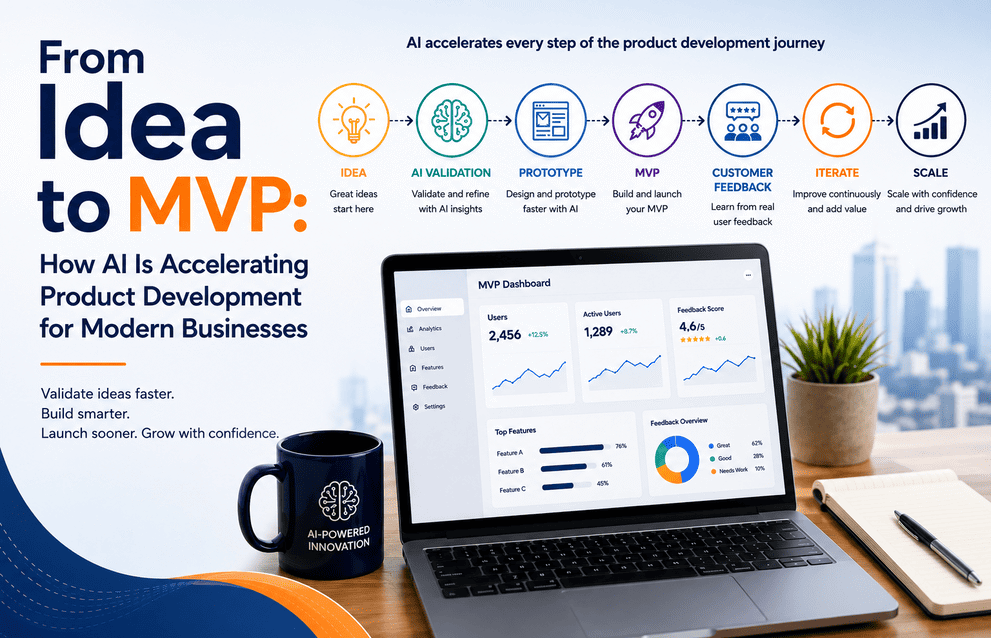
Every business has ideas.
Some have ideas for a new customer portal. Others want to launch a digital service, automate an internal process, or create a SaaS product that solves an industry problem.
The challenge isn’t usually the idea—it’s turning that idea into a working product quickly, affordably, and with confidence.
Traditionally, developing software has been a lengthy and expensive process. Months were spent gathering requirements, designing interfaces, writing code, testing features, and refining the product before customers could even provide feedback.
Today, that landscape has changed.
Artificial Intelligence is transforming how modern businesses build digital products. While AI won’t replace experienced architects, designers, or software engineers, it is helping organizations dramatically reduce the time it takes to validate ideas, build Minimum Viable Products (MVPs), and bring innovative solutions to market.
For small and medium-sized businesses (SMBs), this presents an opportunity to compete with much larger organizations—without requiring enterprise-sized budgets or development teams.
Why Traditional Product Development Takes So Long
Building a successful product has always involved numerous stages, each requiring significant time and coordination.
A typical development journey often includes:
- Business discovery and requirements gathering
- Market and competitor research
- User experience design
- Technical architecture
- Software development
- Quality assurance
- User acceptance testing
- Documentation
- Deployment and support
Each phase depends on the previous one, and changes discovered late in the process can significantly increase costs and delay delivery.
Many businesses spend months building features before learning whether customers actually need them.
That is one of the biggest risks in product development.
How AI Is Transforming Product Development
AI is helping organizations accelerate nearly every stage of the product lifecycle—not by replacing people, but by enabling teams to work smarter and make better decisions faster.
1. Validating Business Ideas Faster
Before writing a single line of code, AI can help businesses:
- Research competitors
- Identify market gaps
- Analyze customer pain points
- Explore potential product features
- Generate business model ideas
- Evaluate pricing strategies
Instead of weeks of research, organizations can quickly develop a clearer understanding of market opportunities and customer expectations.
2. Accelerating Product Planning
Once an idea has been validated, AI can assist in creating:
- Product requirement documents
- User stories
- Acceptance criteria
- Process workflows
- Feature prioritization
- Product roadmaps
This allows product owners and business analysts to spend more time refining strategy rather than creating documentation from scratch.
3. Speeding Up UX and Prototyping
Designers can use AI to rapidly generate:
- Wireframes
- User interface concepts
- Customer journey maps
- Content suggestions
- Navigation structures
Instead of debating static documents, stakeholders can review interactive concepts much earlier in the process, reducing rework and improving collaboration.
4. Improving Development Productivity
Modern AI development tools help engineering teams:
- Generate boilerplate code
- Suggest implementation approaches
- Explain unfamiliar codebases
- Create reusable components
- Detect potential defects early
- Improve documentation
Developers remain responsible for building secure, scalable, and maintainable software, but AI significantly reduces repetitive work, allowing them to focus on solving business problems.
5. Making Testing More Efficient
Quality assurance teams can leverage AI to:
- Generate test cases
- Create test data
- Identify regression risks
- Improve test coverage
- Analyze defects
- Prioritize testing efforts
This shortens testing cycles while improving overall software quality.
6. Enhancing Documentation and Knowledge Sharing
Documentation is often postponed until the end of a project.
AI can automatically help generate:
- Technical documentation
- API documentation
- User manuals
- Release notes
- Training material
- Knowledge base articles
Keeping documentation current becomes much easier throughout the development lifecycle.
Where Human Expertise Still Matters
Despite the impressive capabilities of AI, successful products are still built by experienced people.
AI cannot replace the strategic thinking required to:
- Understand business objectives
- Design scalable solution architectures
- Make technology decisions
- Build secure enterprise-grade applications
- Ensure regulatory compliance
- Deliver exceptional user experiences
- Align technology investments with long-term business goals
The best results come from combining AI with experienced consultants, architects, designers, and engineers who understand both technology and business.
AI accelerates delivery.
People create the strategy.
A Modern AI-Powered MVP Development Approach
Rather than spending months building a “perfect” product, successful organizations now focus on delivering value sooner through iterative development.
A modern MVP journey typically looks like this:
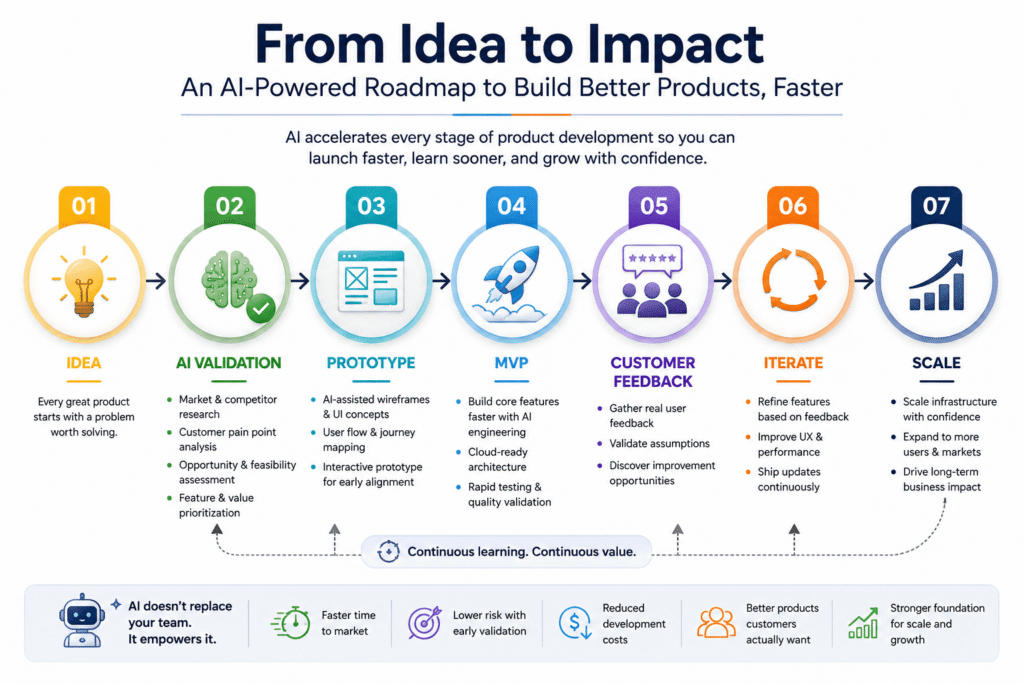
This approach helps businesses:
- Reduce development costs
- Validate assumptions earlier
- Minimize business risk
- Launch products faster
- Improve customer satisfaction
- Continuously evolve based on real-world feedback
Instead of guessing what customers want, organizations learn directly from users and improve with every release.
Common Mistakes Businesses Should Avoid
While AI offers tremendous advantages, it is not a shortcut to successful product development.
Some common mistakes include:
Building Too Much Too Soon
An MVP should solve one core problem exceptionally well—not attempt to deliver every possible feature.
Treating AI as a Replacement for Strategy
AI can generate ideas, but it cannot define your business vision or product strategy.
Ignoring Customer Feedback
Launching quickly only creates value if organizations continuously gather feedback and improve the product.
Overlooking Security and Scalability
Rapid development should never come at the expense of security, performance, accessibility, or future growth.
How Solveloop Helps Businesses Build Smarter Products
At Solveloop, we believe successful products start with understanding the business problem—not simply selecting the latest technology.
Our approach combines strategic consulting, modern software engineering, and AI-powered development practices to help businesses move from concept to MVP with confidence.
We work closely with organizations to validate ideas, define scalable architectures, build cloud-ready solutions, and deliver products iteratively—allowing teams to launch sooner, gather meaningful customer insights, and continuously improve.
Rather than building technology for its own sake, we focus on delivering solutions that create measurable business value and establish a strong foundation for long-term growth.
Conclusion
AI is fundamentally changing how digital products are built.
Organizations no longer need to spend months waiting for a first release before learning whether their ideas resonate with customers.
By combining AI with experienced product strategy, architecture, and engineering, businesses can validate ideas faster, reduce development costs, and deliver value to customers sooner.
The companies that embrace this new way of building products won’t just develop software more efficiently—they’ll innovate more confidently and adapt more quickly to changing market demands.
For SMBs looking to accelerate digital innovation, the question is no longer whether AI should be part of product development.
The real question is:
How quickly can you start turning your next great idea into reality?