Artificial Intelligence is quickly becoming a strategic priority for organizations across every industry. Whether it’s AI-powered search, intelligent virtual assistants, personalized customer experiences, or enterprise copilots, businesses are looking for ways to leverage AI to improve productivity, enhance customer engagement, and make better decisions.
For many organizations already using Liferay DXP, the question is no longer if AI should be part of their digital strategy—it’s how.
The excitement around AI often leads organizations to focus on selecting the right Large Language Model (LLM), chatbot, or AI platform. While these technologies are important, they are only one part of the equation.
The reality is that AI is only as effective as the platform and data behind it.
Without well-structured content, strong governance, clean information architecture, and connected enterprise systems, even the most advanced AI solution will struggle to deliver meaningful business value.
Rather than asking “How do we add AI to Liferay?”, organizations should first ask:
“Is our Liferay DXP ready for AI?”
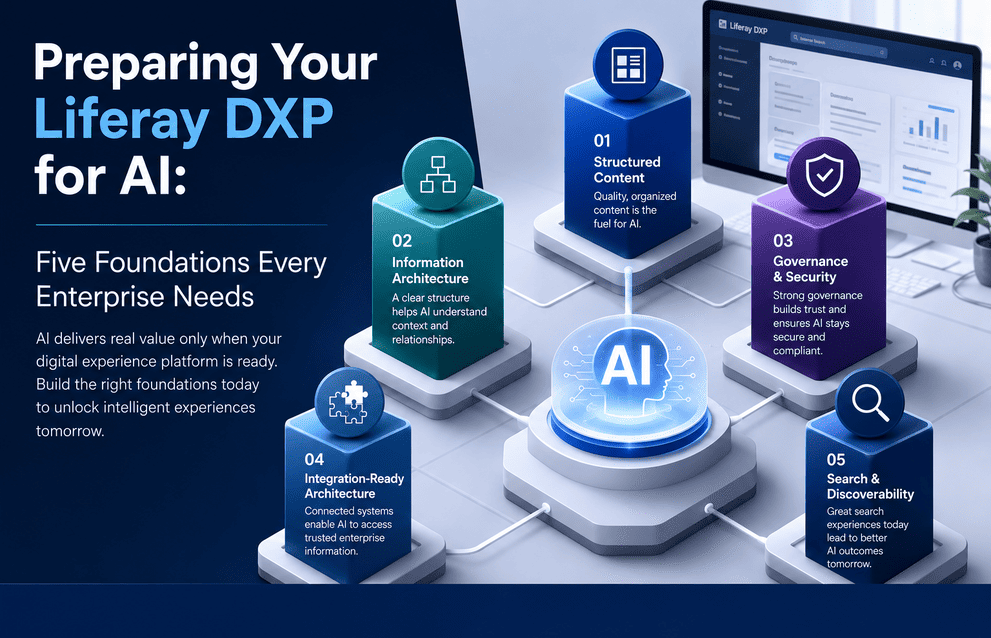
In this article, we’ll explore the five foundational capabilities every enterprise should have in place before introducing AI into their digital experience platform.
Why AI Readiness Matters More Than AI Features
Artificial Intelligence has an incredible ability to improve digital experiences—but it also exposes weaknesses that may already exist within your platform.
If your content is outdated, duplicated, poorly organized, or difficult to search today, AI will simply surface those same problems faster.
Similarly, if permissions are inconsistent or business systems operate in isolation, AI cannot magically create trusted, accurate answers.
Successful AI initiatives begin with a mature digital foundation.
Liferay DXP already provides many of the capabilities organizations need to build that foundation. The key is ensuring these capabilities are implemented thoughtfully and aligned with your long-term digital strategy.
Let’s explore the five areas every organization should evaluate.
1. Structured Content Is the Fuel for AI
One of the biggest advantages of Liferay DXP is its ability to manage structured content instead of relying solely on traditional web pages.
Structured Web Content, metadata, categories, vocabularies, and content types allow information to be organized consistently across the platform.
Why does this matter?
Because AI performs best when information is structured.
Imagine asking an AI assistant:
“What pension benefits are available for retired employees?”
If the answer exists across multiple PDF documents, inconsistent web pages, and duplicated content, AI has to work much harder—and the responses may be incomplete or inaccurate.
On the other hand, when information is organized using structured content models, metadata, and consistent taxonomy, AI can retrieve, understand, and present information much more effectively.
Before implementing AI, organizations should evaluate:
- Are content types standardized?
- Is metadata consistently applied?
- Are categories and taxonomies well defined?
- Is duplicate content minimized?
- Is content regularly reviewed and maintained?
Good AI starts with good content.
2. Information Architecture Creates Context
Information Architecture is often viewed as a user experience exercise, but it’s equally important for AI.
A well-designed Information Architecture helps both users and AI understand how information relates to one another.
When pages, navigation, and content follow a logical hierarchy, AI gains valuable context that improves search, recommendations, and conversational experiences.
Poorly organized websites often contain:
- Multiple versions of the same information
- Confusing navigation
- Broken content relationships
- Inconsistent naming conventions
- Content that is difficult to discover
These issues don’t just frustrate users—they reduce the quality of AI-generated responses.
As organizations modernize their Liferay implementation, Information Architecture should be treated as a strategic investment rather than simply a website design activity.
Clear structure benefits everyone—your customers, your employees, your content authors, and your future AI capabilities.
3. Governance and Security Build Trust
One of the biggest differences between consumer AI and enterprise AI is trust.
Enterprise AI must respect the same governance policies that already protect sensitive business information.
Liferay DXP provides robust capabilities for:
- Role-based permissions
- Approval workflows
- Content versioning
- Publishing controls
- User and group management
- Auditability
These capabilities become even more valuable as organizations introduce AI.
For example, an AI assistant should never expose internal documents to public users or display information that a user is not authorized to access.
Strong governance ensures AI remains secure, compliant, and trustworthy.
Organizations preparing for AI should review:
- Who owns business content?
- Are approval workflows clearly defined?
- Are permissions consistently managed?
- Is outdated content archived appropriately?
- Can information be trusted?
AI should amplify trusted information—not create uncertainty.
4. Connected Enterprise Systems Unlock Real Business Value
Many organizations initially think about AI as a smarter website search.
In reality, the greatest business value comes when AI can securely connect information across multiple enterprise systems.
Liferay DXP already serves as a digital experience platform capable of integrating with a wide range of enterprise applications, including:
- CRM platforms
- ERP systems
- Microsoft 365
- Salesforce
- SAP
- Identity providers
- Document management systems
- Business process platforms
Instead of forcing users to search across disconnected applications, AI can help surface relevant information through a unified digital experience.
However, this is only possible when integrations are designed using scalable APIs, secure authentication, and well-governed data flows.
Organizations that invest in integration today will be significantly better positioned to adopt enterprise AI tomorrow.
5. Search and Discoverability Lay the Foundation for Intelligent Experiences
Before organizations invest in conversational AI, they should ask a simple question:
Can users already find the information they need today?
If traditional enterprise search struggles because of poor metadata, inconsistent content, or weak indexing, AI is unlikely to solve those problems on its own.
In fact, AI often depends on the same search technologies to retrieve relevant enterprise knowledge before generating responses.
Improving discoverability includes:
- Consistent metadata
- High-quality indexing
- Relevant search results
- Well-defined taxonomies
- Content optimization
- Regular content governance
Think of search as the foundation.
AI simply builds on top of it.
Organizations with mature search capabilities typically achieve better outcomes when introducing AI-powered experiences.
A Simple AI Readiness Checklist
Before introducing AI into your Liferay DXP environment, ask yourself these questions:
- Is our content structured and consistently managed?
- Do we have a clear Information Architecture?
- Are permissions and governance well established?
- Are our enterprise systems connected through secure integrations?
- Can users easily discover trusted information today?
If you answered “No” to any of these questions, your next investment should be strengthening these foundations rather than rushing into AI implementation.
Preparing Today for Tomorrow’s Intelligent Experiences
Artificial Intelligence is transforming how organizations deliver digital experiences, but successful AI initiatives don’t begin with choosing a chatbot or connecting an LLM.
They begin with building a platform that AI can trust.
Liferay DXP already provides many of the capabilities organizations need to create that foundation—from structured content and governance to integrations and enterprise search.
Organizations that invest in these capabilities today won’t just be ready for today’s AI technologies—they’ll also be well positioned to adopt future innovations with confidence.
At Solveloop, we believe AI adoption should be guided by strong architecture, thoughtful governance, and practical business outcomes. By helping organizations modernize their digital experience platforms before introducing AI, we ensure that AI becomes more than a feature—it becomes a trusted capability that delivers measurable value for customers, employees, and the business.