For the last several years, conversational AI has been one of the most visible applications of artificial intelligence in digital experiences.
Organizations introduced chatbots to answer frequently asked questions, guide users through websites and reduce the volume of routine support requests. Generative AI took this considerably further, allowing users to ask questions naturally, search large volumes of enterprise knowledge and receive more contextual responses.
But answering questions is only part of the customer or employee journey.
- A customer asking about a delayed order does not necessarily want instructions explaining where to check the shipment. They want to know what happened and, ideally, resolve the problem.
- An employee reporting a laptop issue may not want to understand the organization’s IT service catalog. They simply want their laptop fixed.
- A supplier asking about an unpaid invoice may not want to navigate multiple procurement systems. They want to understand why the invoice has not been paid and what needs to happen next.
This is where the evolution from AI chatbots to AI agents becomes interesting. The next generation of enterprise digital experiences may increasingly move beyond answering questions toward understanding intent, coordinating enterprise systems and helping users accomplish outcomes.
The progression could look something like this:
Traditional Chatbot → AI Assistant → AI Agent → Agentic Digital Experience
The difference is significant.
AI assistants help users understand what to do. AI agents can potentially help them actually do it.
1. The Chatbot Was Only the Beginning
Traditional enterprise chatbots were primarily designed around predefined conversations. Users selected options or asked questions, and the chatbot responded using configured intents, decision trees or frequently asked questions. Generative AI changed that experience dramatically. Instead of forcing users to understand predefined categories, AI assistants can interpret natural-language questions, retrieve relevant enterprise information and generate contextual responses.
For example, a supplier could ask:
“Why hasn’t invoice 45892 been paid?”
An AI-enabled assistant could potentially retrieve the invoice status from an ERP system, search procurement documentation and explain that the invoice is waiting for a purchase-order discrepancy to be resolved. That is already considerably better than directing the supplier to a generic FAQ. But the supplier still needs someone—or another system—to resolve the problem. An AI agent introduces another possibility. With appropriate permissions and enterprise controls, the agent could potentially identify the discrepancy, gather the required information, initiate the appropriate workflow and ask the supplier or procurement team for confirmation when human input is required.
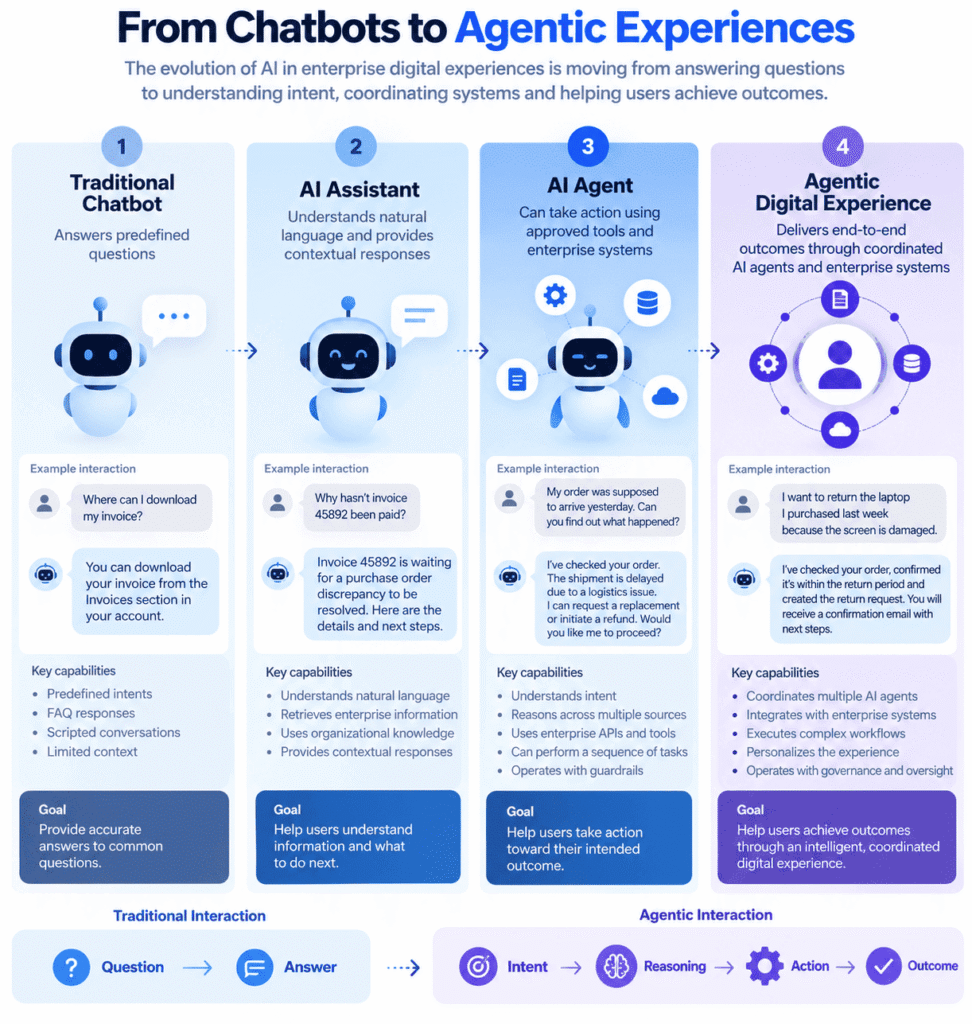
Chatbots answer. Assistants understand. Agents act. Agentic experiences help deliver outcomes.
2. What Changes When AI Becomes Agentic?
The word agent is increasingly used across the technology industry, but the underlying idea is relatively straightforward. Instead of generating a single response, an AI agent can be given a goal and access to approved tools that allow it to perform a sequence of tasks toward that goal.
Consider a customer saying:
“My order was supposed to arrive yesterday. Can you find out what happened?”
A chatbot might provide a link to the order-tracking page. An AI assistant could retrieve the customer’s order and explain its current shipping status. An AI agent could go further. It might retrieve the order, query the logistics provider, determine why the shipment was delayed, review the organization’s delivery policies and identify the available resolution options. Depending on how much autonomy the organization allows, the agent might then ask:
“Your shipment appears to have been lost in transit. I can request a replacement or initiate a refund. Which would you prefer?”
Once the customer approves the action, the agent could initiate the appropriate workflow through enterprise APIs. This represents an important change. The objective is no longer simply to generate the best response. The objective is to help accomplish the user’s intended outcome. However, this does not mean giving AI unrestricted access to enterprise systems. Enterprise agents need clearly defined tools, permissions, business rules, approval processes and auditability.
The challenge is therefore not simply building intelligent agents.
It is building controlled, trustworthy and useful agentic experiences.
3. Why the Digital Experience Layer Still Matters
If AI agents can interact directly with enterprise systems, it might be tempting to ask whether traditional portals and digital experience platforms will still be necessary. In reality, agentic experiences can make the digital experience layer even more important. Enterprise interactions still require context.
- Who is the user?
- Which organization or account do they belong to?
- What products or services do they have?
- What information are they allowed to access?
- Which actions are they authorized to perform?
- What content, applications and experiences should be available to them?
A Digital Experience Platform such as Liferay DXP can provide an important part of this foundation. Liferay can continue managing capabilities such as:
- Authentication and user identity
- Roles and permissions
- Personalized digital experiences
- Content and knowledge
- Forms and workflows
- Customer, employee, supplier and partner portals
- Integration with enterprise applications
The AI agent can then operate within that digital context. This creates an important architectural distinction.
The AI agent does not necessarily replace the portal. It changes what the portal can do.
Instead of requiring users to navigate every application and business process manually, the portal can increasingly become an intelligent interaction layer between users and the systems behind the organization.
4. A Practical Example: From Customer Portal to Agentic Customer Experience
Consider a manufacturing company operating a customer portal built on Liferay DXP. Today, customers may log in to perform activities such as:
- Viewing orders
- Downloading invoices
- Checking shipment status
- Accessing product documentation
- Raising support requests
- Managing account information
These capabilities are valuable, but customers still need to understand how the portal is organized.
Now imagine the customer simply says:
“My order was supposed to arrive yesterday. Find out what happened and help me resolve it.”
An agentic experience could potentially coordinate several steps.
1. Understand the customer – The user’s authenticated Liferay session establishes their identity, organization, account and permissions.
2. Retrieve the order – The agent queries the organization’s ERP or order-management system.
3. Check shipment status – The agent uses an approved logistics API to retrieve current shipment information.
4. Identify the problem – The shipment may be delayed, damaged or potentially lost.
5. Review relevant policies – The agent retrieves approved delivery, replacement and refund policies from enterprise knowledge.
6. Determine available options – Based on the customer’s account, order and organizational policies, the agent identifies the permitted resolution paths.
7. Request approval – Before performing a consequential action, the agent asks the customer to confirm the preferred resolution.
8. Execute the action – The appropriate enterprise API or workflow is invoked.
9. Update relevant systems – CRM, ERP or service-management records can be updated where required.
10. Communicate the outcome
The customer receives confirmation without having to navigate multiple applications or contact several departments. The underlying systems have not disappeared. The ERP still manages orders. The CRM still manages customer information. The logistics platform still manages shipments.
What changes is the experience of interacting with those systems.
5. The Architecture Behind an Agentic Experience
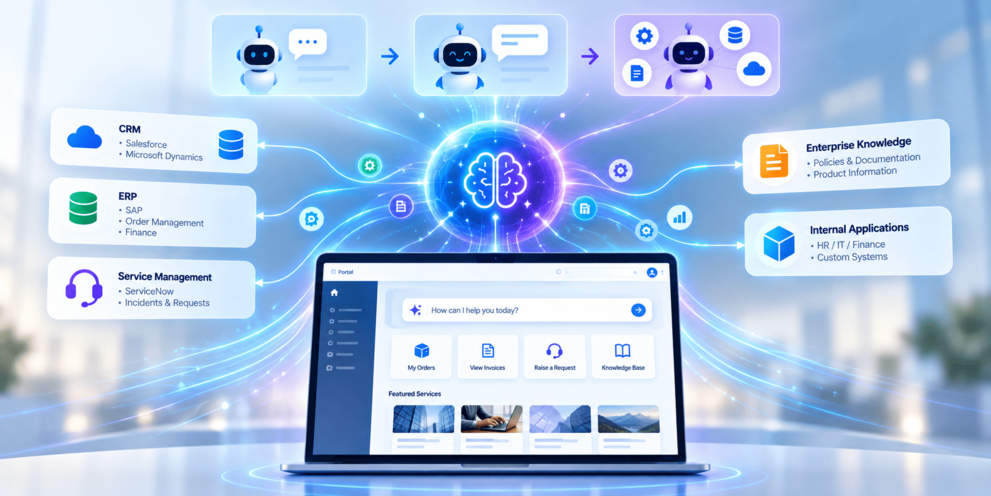
An enterprise agentic experience is unlikely to be a single AI model connected directly to every business system. A more controlled architecture separates the digital experience, AI orchestration and enterprise systems.
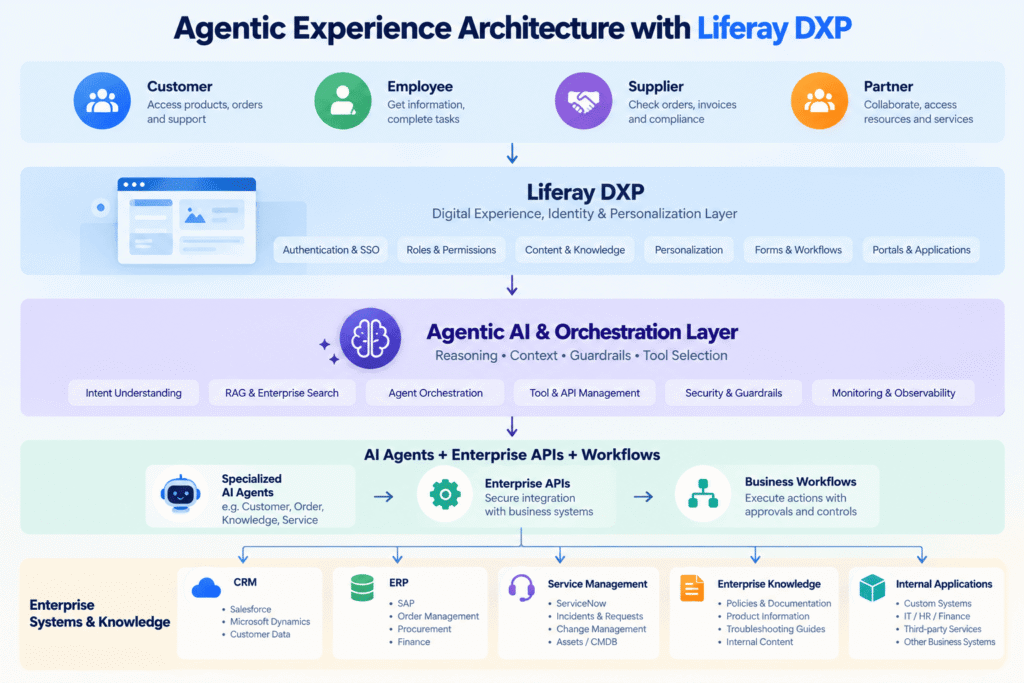
The agentic layer may include capabilities such as large language models, retrieval-augmented generation, agent orchestration, enterprise search, tool calling, workflow engines and AI guardrails. Enterprise systems expose approved capabilities through APIs and integration services. Liferay provides the experience through which authenticated users interact with these capabilities. This separation is important because enterprises need to control not only what the AI knows, but also what the AI is allowed to do.
6. One Agent or a Team of Agents?
Not every business process needs a sophisticated multi-agent architecture. For relatively simple scenarios, a single agent equipped with a small number of carefully controlled tools may be sufficient. More complex enterprise processes, however, could benefit from specialized agents responsible for different areas.
Consider a customer-service scenario.
A Customer Service Agent could understand the user’s request and coordinate the overall interaction.
An Order Agent could retrieve orders, invoices and shipment information through ERP APIs.
A Knowledge Agent could search approved policies, product documentation and troubleshooting information.
A Service Agent could interact with a platform such as ServiceNow to retrieve or create service requests.
A Communication Agent could help generate contextual notifications or follow-up communications.
These agents could collaborate through an orchestration layer while remaining constrained to specific responsibilities and tools.
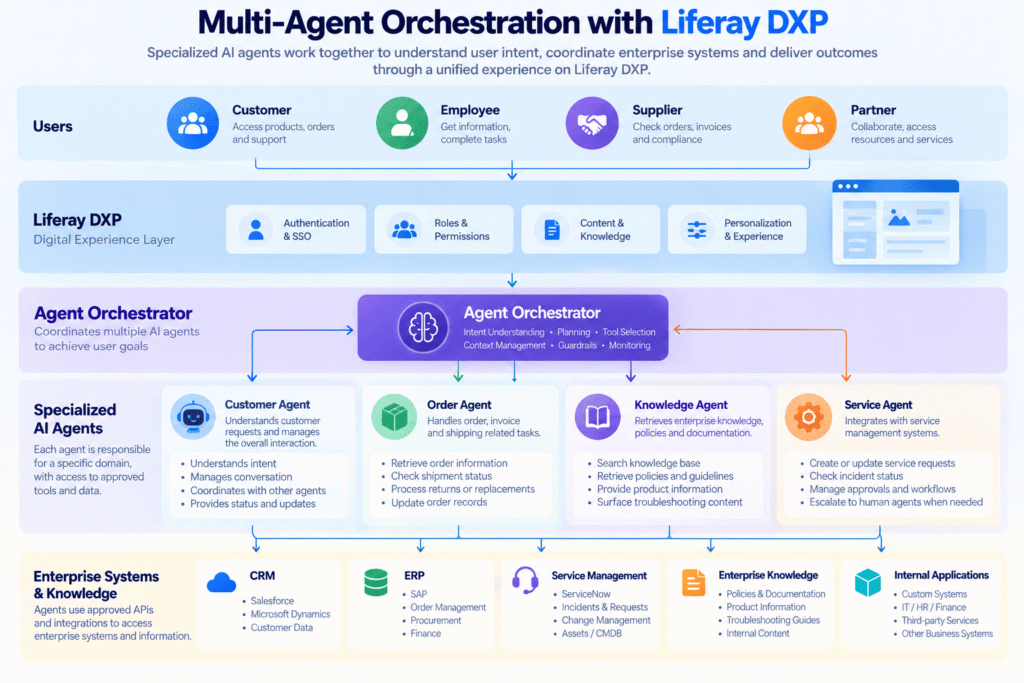
The important principle, however, is not to introduce multiple agents simply because the technology supports them. Architecture should follow the business problem. If a deterministic workflow or conventional API integration can solve the problem reliably, introducing additional AI agents may only increase complexity. Agentic architecture becomes valuable when the task genuinely requires dynamic reasoning, context and coordination across different capabilities.
7. From Pages and Portlets to Intent-Driven Experiences
Perhaps one of the most interesting implications of agentic AI is how it could change portal design itself. Traditional portals are largely navigation-driven.
A user typically follows a journey such as:
Login → Navigate → Find Application → Find Record → Complete Form → Submit → Track
Organizations spend considerable effort designing information architecture, menus, dashboards and application navigation to make these journeys easier.
Agentic experiences introduce another interaction model.
Express Intent → Understand Context → Coordinate Systems → Confirm Action → Deliver Outcome
Consider a customer wanting to return a damaged laptop.
Today, the journey might look like:
My Account → Orders → Order #12345 → Returns → Create Return → Select Reason → Submit
With an agentic experience, the customer could simply say:
“I want to return the laptop I purchased last week because the screen is damaged.”
The AI already has important context.
- It knows who the customer is.
- It can retrieve recent purchases.
- It can identify the laptop.
- It can retrieve the return policy.
- It can determine whether the product is eligible.
- It can ask for any missing information.
And, with the customer’s approval, it could initiate the return workflow.
This does not mean navigation, pages and applications disappear.
Instead, the digital experience begins supporting two complementary interaction models:
traditional navigation for users who want direct control, and intent-driven interactions for users who simply want to accomplish something.
8. Enterprise Agents Need Guardrails
Giving AI the ability to take actions introduces responsibilities that are very different from those associated with a chatbot answering questions.
An incorrect chatbot response can create confusion. An incorrectly executed action could potentially change customer information, create transactions or trigger business processes. Agentic systems therefore need strong governance.
A useful model is:
Authentication → Authorization → Data Access → Tool Permissions → Human Approval → Audit Trail → Observability
The level of autonomy should also reflect the consequence of the action.
For example →
- Retrieving an order status may require little additional approval beyond authenticated access.
- Changing a shipping address may require explicit confirmation.
- Issuing a refund may require additional business rules.
- Approving a high-value financial transaction could require human authorization.
A practical principle for enterprise agentic AI is:
The more consequential the action, the stronger the controls around agent autonomy should be.
Organizations also need visibility into what agents are doing.
- Which tools were invoked?
- Which information was accessed?
- Why was a particular action proposed?
- Who approved it?
- What changes were made to enterprise systems?
These questions become essential when moving AI from answering questions to participating in business processes.
9. Start Small: An Agentic AI Adoption Path
Organizations do not need to transform their entire digital platform into an autonomous AI environment. A progressive adoption model can reduce risk while allowing teams to learn where agentic capabilities provide genuine value.
Stage 1 — Conversational – AI answers questions using approved enterprise knowledge. The primary objective is improving information discovery and reducing dependency on navigation and search.
Stage 2 — Contextual – AI combines enterprise knowledge with authenticated user context and business data. Instead of answering generic questions, it can provide responses relevant to a specific customer, employee, supplier or partner.
Stage 3 — Assisted Actions – AI can identify the appropriate action and prepare it, but the user or an employee approves execution. This is an important transition because organizations can introduce agentic capabilities while retaining human control.
Stage 4 — Agentic Workflows – Agents can coordinate multiple approved tools and systems to complete defined business processes. Human approval remains available at appropriate checkpoints.
Stage 5 — Agentic Experiences – Agentic capabilities become embedded throughout the digital experience, allowing users to express intent while AI coordinates the underlying systems required to achieve outcomes.
The objective should not necessarily be reaching Stage 5 for every process. Some processes should remain deterministic.
Some actions should always require human approval. The right level of autonomy depends on business value, risk, regulatory requirements and the reliability of the underlying systems.
10. From Digital Experience Platform to Agentic Experience Platform
Digital experience platforms have traditionally helped organizations bring together content, applications, data and services into unified experiences.
AI agents introduce another layer to that evolution.
Instead of requiring users to understand how enterprise systems are structured, digital experiences can increasingly begin understanding what users are trying to accomplish.
Liferay DXP can continue providing the experience, identity, content, personalization and integration foundation.
Enterprise systems such as CRM, ERP and service-management platforms can continue managing the business processes and transactional data they were designed to manage.
The AI and orchestration layer can connect these capabilities by understanding intent, reasoning across available context and invoking approved tools.
The result is not necessarily an autonomous enterprise where AI replaces applications, workflows or people.
It is a digital experience where those capabilities become easier to access and coordinate.
The next generation of enterprise portals may therefore be defined less by how many applications they expose and more by how effectively they help users accomplish their goals.
Chatbots answer. Assistants understand. Agents act.
And agentic digital experiences bring those capabilities together to help users move from intent to outcome.
The future of enterprise portals may not be about giving users more functionality to navigate.
It may be about creating intelligent experiences that understand intent, coordinate complexity and help deliver outcomes.