Introduction
Artificial Intelligence has moved well beyond being a technology reserved for large enterprises. Today, affordable AI solutions and intelligent automation platforms allow small and medium-sized businesses (SMBs) to improve efficiency, reduce manual work, and deliver better customer experiences without replacing their existing systems.
Yet many organizations struggle with one simple question:
Where should we actually start?
The answer isn’t to automate everything overnight. Successful AI adoption begins by identifying repetitive, time-consuming processes that consume valuable employee time but add little strategic value.
Whether your organization has 10 employees or 500, there are likely dozens of daily activities that could be completed faster, more accurately, and more consistently with AI.
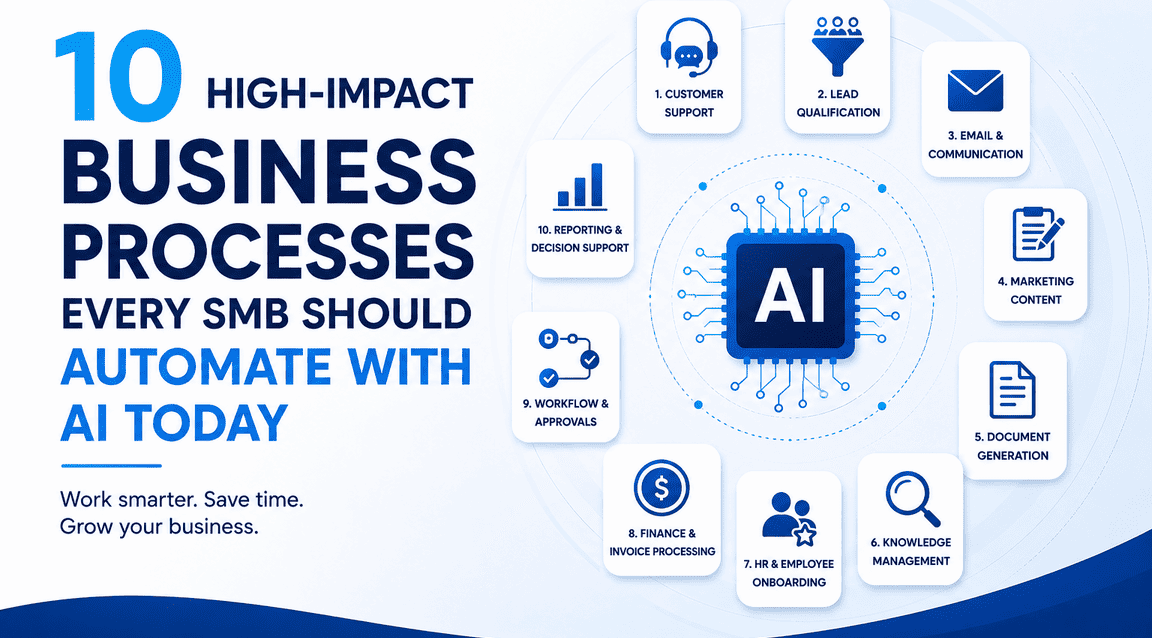
In this article, we’ll explore ten high-impact business processes that SMBs should consider automating today, along with the benefits and practical examples of how AI can help.
| Business Process | Primary Business Owner | Implementation Effort | Business Impact |
|---|---|---|---|
| Customer Support & FAQs | Customer Service Manager / Operations | Low | High |
| Sales Lead Qualification | Sales Manager | Low | High |
| Email & Communication Management | Every Department | Low | Medium-High |
| Marketing Content Creation | Marketing Manager | Low | High |
| Document & Proposal Generation | Sales / Delivery / PMO | Medium | High |
| Internal Knowledge Management | IT / Operations / HR | Medium | High |
| Employee Onboarding & HR | HR Manager | Medium | Medium-High |
| Finance & Invoice Processing | Finance Manager | Medium | High |
| Workflow & Approval Automation | Operations Manager | Medium | High |
| Business Reporting & Decision Support | Executives / Management | Medium-High | Very High |
Quick Tip: If you’re beginning your AI journey, prioritize processes that combine low implementation effort with high business impact. These “quick wins” build confidence, demonstrate measurable ROI, and create momentum for broader AI adoption across the organization.
What Makes a Business Process a Good Candidate for AI?
Before investing in AI, it’s important to evaluate whether a process is actually suitable for automation.
Generally, the best candidates are processes that are:
- Repetitive and performed frequently
- Rule-based with predictable decision-making
- Time-consuming and manually intensive
- Prone to human error
- Dependent on information spread across multiple systems
- Slowing down employees from focusing on higher-value work
1. Customer Support and Frequently Asked Questions
Customer support is often the first area where SMBs see immediate value from AI.
Many businesses spend countless hours responding to repetitive questions such as:
- Where is my order?
- What are your business hours?
- How much does your service cost?
- How do I reset my password?
- How can I book an appointment?
An AI-powered virtual assistant can provide instant responses 24/7, gather relevant customer information, and seamlessly escalate more complex inquiries to your support team when necessary.
Business Benefits
- Faster customer response times
- Reduced support workload
- Improved customer satisfaction
- Consistent responses across channels
- Better scalability without increasing support staff
Typical AI Tools & Technologies
- AI virtual assistants and conversational chatbots
- Customer service automation platforms
- CRM integrations
- Knowledge base search
- Omnichannel messaging platforms
2. Sales Lead Qualification
Responding quickly to new inquiries can significantly improve conversion rates, yet many SMBs rely on manual follow-ups that are often delayed.
AI can automatically:
- Qualify inbound leads
- Ask follow-up questions
- Capture customer requirements
- Score lead quality
- Schedule meetings
- Route leads to the appropriate sales representative
Instead of spending time identifying which prospects are serious, your sales team can focus on building relationships and closing deals.
Business Benefits
- Faster response to new leads
- Higher conversion rates
- Better use of sales resources
- Improved customer experience
Typical AI Tools & Technologies
- AI sales assistants
- CRM automation
- Lead scoring engines
- Intelligent web forms
- Meeting scheduling automation
3. Email and Communication Management
Many professionals spend several hours each day reading, organizing, and responding to emails.
AI assistants can help by:
- Summarizing lengthy email conversations
- Drafting professional responses
- Prioritizing urgent messages
- Categorizing incoming requests
- Extracting action items from conversations
- Scheduling follow-up reminders
Rather than replacing email, AI helps employees spend less time managing their inbox and more time delivering value.
Business Benefits
- Increased employee productivity
- Faster response times
- Reduced administrative workload
- Improved communication consistency
Typical AI Tools & Technologies
- AI email assistants
- Intelligent inbox management
- Meeting summarization
- Calendar automation
- Collaboration platform integrations
4. Marketing Content Creation
Maintaining a consistent marketing presence is often challenging for SMBs with limited resources.
AI can accelerate content creation by assisting with:
- Blog article outlines
- LinkedIn posts
- Email newsletters
- Website copy
- Product descriptions
- SEO optimization
- Campaign ideas
It’s important to note that AI should enhance human creativity—not replace it. The most effective marketing still requires industry expertise, strategic messaging, and editorial review.
Business Benefits
- Consistent marketing output
- Reduced content creation time
- Better search engine visibility
- Increased brand awareness
Typical AI Tools & Technologies
- Generative AI content assistants
- SEO optimization platforms
- Social media publishing tools
- Content planning solutions
- Marketing workflow automation
5. Document and Proposal Generation
Many organizations repeatedly create similar documents including:
- Business proposals
- Statements of Work
- Meeting summaries
- Project documentation
- Standard operating procedures
- Client reports
AI can generate first drafts using predefined templates, summarize meetings, extract key decisions, and automatically populate repetitive sections.
Employees spend less time formatting documents and more time refining business value.
Business Benefits
- Faster document creation
- Improved consistency
- Reduced manual effort
- Better knowledge capture
Typical AI Tools & Technologies
- Document intelligence platforms
- AI writing assistants
- Proposal automation
- Electronic document workflows
- Contract lifecycle management solutions
6. Internal Knowledge Management
As businesses grow, valuable knowledge becomes scattered across emails, documents, shared drives, and collaboration platforms.
Employees frequently ask questions like:
- Where is the latest process document?
- What’s our travel policy?
- Has this issue been solved before?
- Where can I find the latest project template?
AI-powered knowledge assistants can search across internal repositories and provide accurate answers within seconds.
Business Benefits
- Faster employee onboarding
- Improved productivity
- Reduced dependency on subject matter experts
- Better knowledge retention
Typical AI Tools & Technologies
- Enterprise AI search
- Knowledge management platforms
- Document repositories
- Intranet and digital workplace solutions
- AI-powered employee assistants
7. Employee Onboarding and HR Operations
Human Resources teams spend considerable time coordinating repetitive administrative tasks.
AI can assist with:
- Employee onboarding checklists
- Document collection
- Policy acknowledgements
- Training recommendations
- Interview scheduling
- Frequently asked HR questions
This allows HR professionals to focus on employee engagement rather than repetitive administration.
Business Benefits
- Improved onboarding experience
- Reduced HR administration
- Faster employee productivity
- Consistent onboarding process
Typical AI Tools & Technologies
- HR workflow automation
- Employee self-service portals
- AI HR assistants
- Digital forms
- Learning management integrations
8. Finance and Invoice Processing
Finance teams often manage repetitive activities that are highly structured and rule-based.
AI can help automate:
- Invoice data extraction
- Expense categorization
- Payment reminders
- Financial reporting
- Purchase order validation
- Anomaly detection
Importantly, AI complements existing accounting software rather than replacing it.
Typical AI Tools & Technologies
- Intelligent document processing
- OCR and invoice recognition
- Expense automation
- Financial workflow automation
- ERP integrations
Business Benefits
- Faster financial processing
- Fewer manual errors
- Better cash flow visibility
- Reduced administrative costs
9. Workflow Approvals and Business Processes
Many organizations continue to rely on email chains for approvals.
Examples include:
- Leave requests
- Purchase approvals
- Contract approvals
- Marketing content reviews
- Expense approvals
- Project sign-offs
AI-powered workflow automation ensures requests are routed to the appropriate stakeholders, reminders are sent automatically, and approval status remains visible throughout the process.
Business Benefits
- Faster decision-making
- Improved transparency
- Reduced process delays
- Better compliance
Typical AI Tools & Technologies
- Workflow orchestration platforms
- Low-code automation solutions
- Digital approval workflows
- Business process management (BPM)
- Notification and collaboration integrations
10. Business Reporting and Decision Support
Managers often spend hours collecting information from multiple systems before making decisions.
AI can consolidate business data and provide:
- Executive summaries
- Trend analysis
- Performance insights
- Risk identification
- KPI monitoring
- Natural language reporting
Rather than replacing dashboards, AI helps decision-makers understand what the data actually means.
Business Benefits
- Faster business insights
- Better strategic decisions
- Reduced reporting effort
- Increased operational visibility
Typical AI Tools & Technologies
- Business intelligence platforms
- AI analytics assistants
- Executive dashboards
- Data visualization tools
- Predictive analytics and reporting solutions
Common Mistakes SMBs Make When Adopting AI
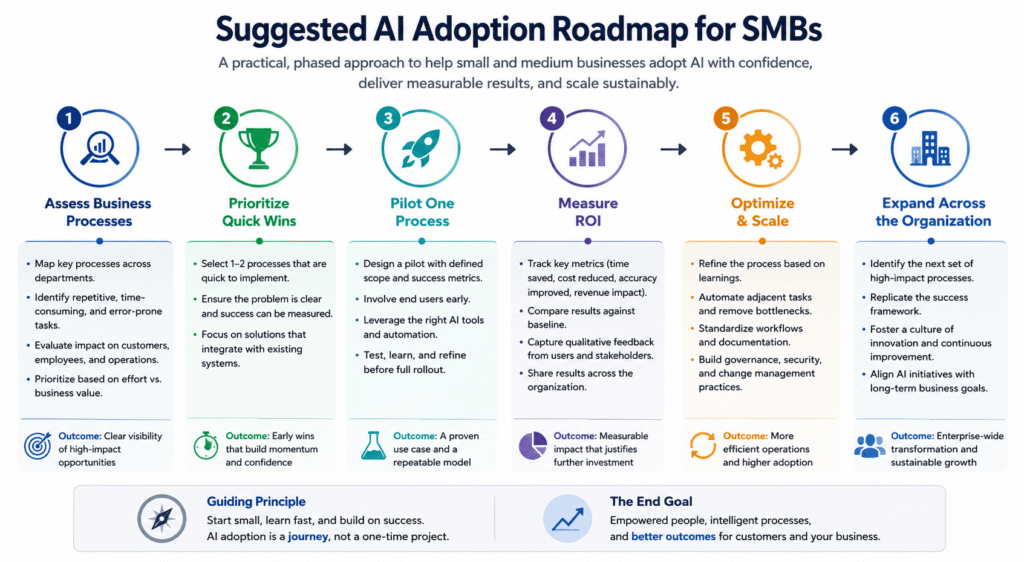
Many organizations rush into AI projects expecting immediate transformation. In reality, successful adoption requires a thoughtful, phased approach.
Some common mistakes include:
- Trying to automate every process at once
- Purchasing AI tools before defining business objectives
- Automating inefficient processes instead of improving them first
- Ignoring employee training and adoption
- Expecting AI to replace human expertise entirely
The most successful SMBs start with one or two high-impact processes, measure the results, and expand gradually as their teams gain confidence.
How Solveloop Helps SMBs Automate Smarter
Every business is different, and there is no one-size-fits-all approach to AI adoption.
At Solveloop, we begin by understanding how your organization operates, identifying repetitive and high-impact business processes, and recommending practical AI solutions that integrate with your existing technology landscape. Rather than introducing unnecessary complexity, we focus on delivering measurable business outcomes through intelligent automation, AI-powered applications, and modern digital experiences.
Whether you’re looking to streamline customer support, automate internal workflows, modernize legacy processes, or improve operational visibility, our goal is to help your business scale efficiently while maximizing the value of your existing technology investments.
Conclusion
AI automation is no longer a future initiative—it is becoming a competitive advantage for businesses of every size.
The organizations seeing the greatest success aren’t necessarily those investing the most in AI. They’re the ones identifying repetitive work, improving employee productivity, and adopting AI in a practical, measurable way.
Start small. Choose one business process that consumes unnecessary time today, measure the impact, and build from there. Over time, these incremental improvements can transform how your organization operates, enabling your team to spend less time on repetitive tasks and more time delivering value to customers and growing the business.