For years, digital transformation initiatives focused on modernizing existing systems, streamlining operations, and improving customer experiences incrementally. Organizations invested heavily in cloud adoption, platform modernization, automation, and process optimization to remain competitive in rapidly evolving markets.
Today, however, the conversation has fundamentally changed.
The rise of Artificial Intelligence—particularly Generative AI—is redefining how businesses operate, innovate, and grow. What was once considered a technology-led transformation initiative has now become an executive-driven business transformation strategy. AI is no longer just another capability layered onto existing systems; it is rapidly becoming the foundation for how modern enterprises make decisions, create products, engage customers, and scale operations.
At Solveloop, we see AI not as a standalone technology trend, but as a strategic accelerator that enhances digital transformation, cloud engineering, enterprise modernization, and product innovation.
AI Is Reshaping Enterprise Transformation
Traditional transformation programs often focused on improving “business-as-usual” operations. While modernization initiatives delivered value, many organizations still operated within linear growth models constrained by manual processes, disconnected systems, and reactive decision-making.
AI changes that equation entirely.
Organizations are now moving from process optimization toward intelligent business orchestration—where systems can analyze, predict, automate, and continuously improve outcomes at scale.
This shift is enabling enterprises to:
- Accelerate innovation cycles
- Improve operational agility
- Reduce time-to-market
- Enhance customer engagement
- Enable smarter decision-making
- Unlock entirely new business models
The enterprises leading this transformation are not simply adopting AI tools. They are rethinking how technology, people, and processes work together.
Core Pillars of AI-Driven Innovation
Data-to-Insight Acceleration
Modern enterprises generate enormous volumes of operational, customer, transactional, and behavioral data. Yet data alone has little value unless organizations can convert it into actionable intelligence quickly.
AI, combined with scalable cloud platforms and High Performance Computing (HPC), allows businesses to process and analyze massive datasets in near real-time. This dramatically compresses the time required for analytics, forecasting, product development, and strategic decision-making.
The result is faster innovation, quicker response to market changes, and significantly improved business agility.
For organizations pursuing cloud modernization or digital platform transformation, AI-driven analytics is rapidly becoming a core business capability rather than an optional enhancement.
Intelligent Automation Beyond Rule-Based Systems
Traditional automation focused primarily on repetitive, rules-driven workflows. While valuable, these automations were often rigid and limited in scope.
AI-powered automation introduces a new level of intelligence.
Using Machine Learning (ML), Natural Language Processing (NLP), and Generative AI, enterprises can now automate complex tasks involving unstructured data such as documents, emails, images, voice interactions, and customer conversations.
This enables businesses to:
- Streamline operations
- Reduce manual effort
- Improve process accuracy
- Enhance service delivery
- Accelerate response times
- Minimize operational bottlenecks
At Solveloop, we see intelligent automation as a critical evolution of enterprise modernization—particularly for organizations modernizing legacy platforms, customer portals, internal workflows, and digital service ecosystems.
Hyper-Personalized Digital Experiences
Customer expectations have evolved significantly. Users no longer expect generic digital experiences; they expect relevant, contextual, and personalized interactions across every touchpoint.
AI enables enterprises to deliver hyper-personalization at scale by continuously analyzing customer behavior, preferences, intent, and engagement patterns.
This allows businesses to create:
- Personalized recommendations
- Dynamic customer journeys
- Intelligent support experiences
- Context-aware content delivery
- Tailored product and service interactions
For organizations investing in digital experience platforms, AI becomes a major differentiator in driving customer loyalty, engagement, and long-term retention.
Decision Augmentation and Strategic Intelligence
One of the most impactful capabilities of AI is its ability to augment human decision-making.
AI systems can process vast datasets, evaluate risks, simulate scenarios, and identify patterns that may otherwise remain hidden. Rather than replacing leadership judgment, AI strengthens it by providing faster, evidence-based insights.
This enables organizations to transition from reactive operations to proactive strategy execution.
Business leaders can leverage AI to:
- Improve forecasting accuracy
- Enhance operational planning
- Reduce risk exposure
- Optimize resource allocation
- Identify emerging opportunities
- Support strategic transformation initiatives
The organizations gaining the most value from AI are those using it as a collaborative decision-support system rather than treating it purely as an automation tool.
From Linear Growth to Exponential Transformation
The true power of AI lies in its ability to combine two critical capabilities:
Automation
Improving efficiency by streamlining existing processes, reducing costs, and increasing operational consistency.
Augmentation
Unlocking entirely new opportunities by enabling innovation, accelerating creativity, and enhancing strategic capabilities.
Organizations that successfully balance both automation and augmentation position themselves for exponential growth rather than incremental improvement.
This shift allows businesses to:
- Adapt faster to market changes
- Launch products more rapidly
- Scale innovation efficiently
- Disrupt traditional business models
- Create competitive differentiation
AI is not simply about doing existing work faster—it is about enabling organizations to operate differently.
The Risks of Accelerating Too Fast
While AI presents enormous opportunities, organizations often underestimate the operational and organizational complexity involved in large-scale AI adoption.
The pressure to move quickly can lead to what many organizations experience as “time over-compression”—where unrealistic delivery timelines, fragmented implementation strategies, and rushed deployments create instability instead of innovation.
This can result in:
- Increased technical debt
- Operational disruptions
- Security vulnerabilities
- Rising implementation costs
- Workforce burnout
- Failed transformation initiatives
Successful AI adoption requires a strong architectural and operational foundation.
At Solveloop, we strongly believe that sustainable innovation begins with architecture-first transformation strategies that prioritize scalability, governance, security, and long-term business alignment.
Building a Strong Foundation for AI Transformation
Data Readiness and Security
AI systems are only as effective as the quality of the data powering them.
Poorly governed, fragmented, or biased data can produce unreliable insights and weaken decision-making processes. Additionally, rapid AI integration introduces new cybersecurity and compliance risks that organizations must proactively manage.
Enterprises must invest in:
- Strong data governance frameworks
- Cloud-native security models
- Responsible AI practices
- Identity and access management
- Privacy and compliance controls
- Scalable data architecture
Without these foundational elements, AI initiatives can quickly become difficult to scale or sustain.
Closing the Skills Gap
Technology is evolving faster than many organizations can adapt.
The growing demand for AI, cloud, automation, and data engineering expertise has created a substantial skills gap across industries.
Organizations must focus on:
- Upskilling existing teams
- Building AI literacy across departments
- Creating structured learning pathways
- Encouraging experimentation and innovation
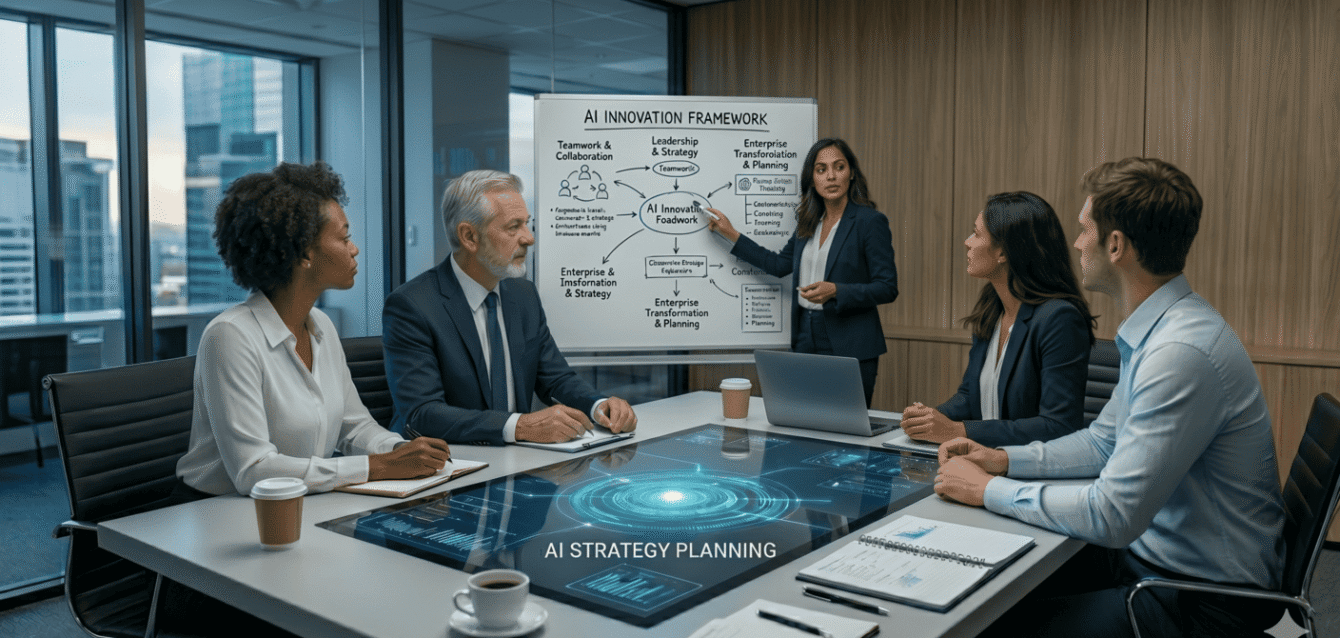
- Developing cross-functional collaboration models
The future workforce will not be defined solely by technical specialists—it will be shaped by organizations that successfully integrate business knowledge, technology expertise, and continuous learning cultures.
Culture and Change Management
One of the biggest barriers to AI transformation is not technology—it is organizational resistance.
Employees often fear that AI will replace jobs rather than enhance capabilities. Successful organizations address this challenge through transparent communication, collaborative transformation strategies, and a culture that positions AI as an enabler of human potential.
Businesses that succeed with AI transformation typically:
- Encourage innovation and experimentation
- Promote continuous learning
- Foster collaboration across teams
- Build trust around AI usage
- Demonstrate how AI amplifies human capabilities
Transformation becomes sustainable when people view AI as a strategic partner rather than a threat.
The Future of Enterprise Innovation
The AI shift marks a turning point in enterprise transformation.
We are moving beyond traditional modernization initiatives into an era defined by continuous innovation, intelligent systems, and adaptive business models. Organizations that align AI with clear business objectives, scalable architecture, cloud-native engineering, and people-focused transformation strategies will be best positioned to lead their industries.
At Solveloop, we help organizations navigate this transformation through architecture-first digital strategy, cloud engineering, intelligent automation, and modern digital platform development designed for long-term scalability and innovation.
The future will belong to businesses that can evolve continuously—and AI is rapidly becoming the engine driving that evolution.
Final Thoughts
AI is no longer a future concept or experimental capability. It is actively reshaping how enterprises operate, compete, and innovate.
The organizations that succeed will not simply adopt AI tools—they will build resilient digital foundations, modernize intelligently, empower their workforce, and create scalable ecosystems capable of adapting continuously.
The shift has already begun.
The question is no longer whether businesses should embrace AI-driven transformation—but how quickly and strategically they can evolve to lead in the next era of enterprise innovation.