Artificial Intelligence has quickly become part of everyday business conversations. From generating emails and marketing content to summarizing meetings and writing code, AI assistants like ChatGPT, Microsoft Copilot, Google Gemini, and Claude have made AI accessible to businesses of every size.
For many small and medium-sized businesses (SMBs), this has been the first real exposure to AI. Teams are becoming more productive, tasks are completed faster, and employees are discovering new ways to work.
But here’s the reality.
Using AI assistants doesn’t automatically make your business AI-powered.
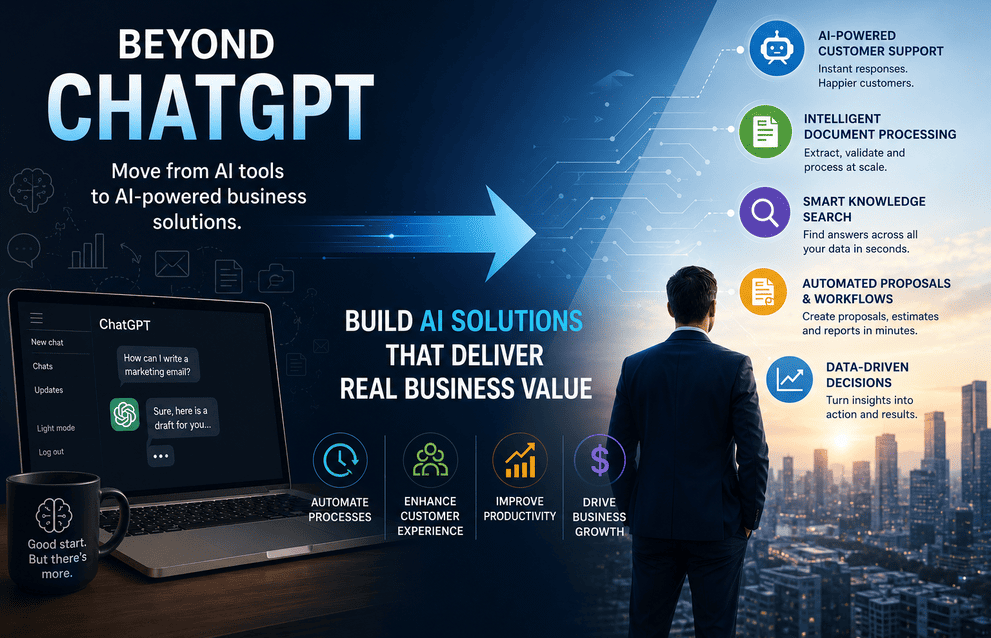
The organizations creating a real competitive advantage are not simply asking AI better questions—they are embedding AI into their business processes, customer experiences, and software applications. They’re using AI to automate work, improve decision-making, enhance customer service, and build entirely new digital capabilities.
This is where the conversation shifts from using AI to building AI solutions.
In this article, we’ll explore what that journey looks like, the common mistakes businesses make, and a practical roadmap for implementing AI in ways that deliver measurable business value.
Using AI Tools Isn’t the Same as Becoming an AI-Powered Business
Most businesses today have reached what I would call the first stage of AI adoption.
Employees use ChatGPT to draft emails.
Marketing teams create social media content with AI.
Developers use GitHub Copilot to write code.
Sales teams generate proposals faster.
These are valuable productivity improvements.
However, they remain individual productivity gains.
The business itself hasn’t fundamentally changed.
Employees still manually transfer information between systems. Customer service teams continue answering repetitive questions. Sales teams still spend hours creating proposals. Operations teams still process invoices, contracts, and documents manually.
AI is simply helping people perform the same work a little faster.
True digital transformation begins when AI becomes part of how the business operates.
The Five Stages of AI Adoption
Businesses typically evolve through five stages as they mature their AI capabilities.
Stage 1 – AI Assistants
This is where most organizations begin.
Employees use AI tools such as ChatGPT, Microsoft Copilot, Gemini, or Claude to assist with day-to-day tasks.
Typical use cases include:
- Writing emails and reports
- Creating marketing content
- Brainstorming ideas
- Research and summarization
- Code generation
- Translation
The primary benefit is improved individual productivity.
While valuable, AI remains an assistant that supports employees rather than becoming part of the business itself.
Stage 2 – AI Automation
The next step is allowing AI to automate repetitive work.
Instead of simply generating content, AI starts performing business tasks.
Examples include:
- Automatically classifying emails
- Extracting data from invoices
- Processing customer enquiries
- Summarizing meetings
- Categorizing documents
- Qualifying incoming sales leads
The result is reduced manual effort, faster turnaround times, and fewer repetitive administrative tasks.
Stage 3 – AI Workflows
This is where AI begins participating in complete business processes.
Instead of assisting with individual tasks, AI becomes part of an end-to-end workflow.
For example, a customer submits an online enquiry.
AI understands the request, extracts relevant information, creates a case in the CRM, routes it to the correct department, generates a draft response, and presents it to an employee for review before sending it to the customer.
Rather than automating isolated activities, the entire workflow becomes more intelligent and efficient.
Stage 4 – AI Agents
AI agents represent another significant leap.
Unlike AI assistants that respond to prompts, AI agents can perform work autonomously within defined boundaries.
Examples include:
- Customer Support Agent
- Sales Assistant
- HR Assistant
- Procurement Agent
- Internal Knowledge Assistant
These agents can search enterprise systems, retrieve information, trigger workflows, generate documents, interact with customers, and complete multi-step tasks while keeping employees informed and in control.
Employees shift from performing routine work to supervising intelligent systems.
Stage 5 – AI-Powered Business Applications
This is where AI becomes invisible.
Customers no longer think they’re “using AI.”
Instead, they simply experience smarter applications.
Imagine a customer portal where users ask:
“I need my invoice from last month.”
Instead of navigating menus or searching documents, AI instantly retrieves the correct invoice.
Or consider an employee portal where someone asks:
“What’s our travel reimbursement policy?”
Rather than searching through folders or SharePoint sites, AI provides the answer immediately along with links to the relevant documentation.
Similarly, a salesperson uploads meeting notes, and the CRM automatically updates customer records, identifies follow-up actions, schedules reminders, and prepares a proposal.
At this stage, AI is no longer an additional tool.
It becomes part of the business application itself.
Real Business Use Cases for SMBs
One of the biggest misconceptions is that AI is only valuable for large enterprises.
In reality, SMBs often benefit even more because they operate with leaner teams and tighter budgets.
Here are a few practical examples.
Customer Support
AI-powered assistants can answer common customer questions instantly, retrieve order information, guide users through processes, and escalate only complex cases to human agents.
The result is faster response times and improved customer satisfaction.
Sales & Proposal Generation
Sales teams often spend hours preparing proposals.
AI can automatically gather customer information, reuse approved content, recommend suitable services, estimate effort, and generate professional proposals in minutes.
This allows sales teams to focus on building relationships rather than formatting documents.
Internal Knowledge Search
Every organization accumulates thousands of documents, policies, presentations, and technical resources.
Instead of searching multiple folders, employees simply ask questions in natural language.
AI searches across internal systems and delivers accurate answers within seconds.
Knowledge becomes instantly accessible across the organization.
Intelligent Document Processing
Many SMBs still manually process invoices, contracts, purchase orders, and application forms.
AI can extract structured information, validate data, identify missing details, summarize documents, and automatically trigger the next step in the approval process.
This dramatically reduces administrative effort while improving accuracy.
AI-Powered Customer Portals
Rather than offering static portals with forms and menus, businesses can provide conversational experiences.
Customers can ask questions, submit requests, track orders, access documents, and receive personalized assistance without needing to navigate complex websites.
This creates a significantly better customer experience while reducing operational costs.
Common Mistakes Businesses Make
As AI adoption accelerates, many organizations make similar mistakes.
Mistake 1 – Buying AI Licenses Without a Strategy
Purchasing AI subscriptions is easy.
Creating measurable business outcomes requires understanding where AI will deliver the greatest value.
Technology should always support business objectives.
Mistake 2 – Trying to Automate Everything
Not every business process needs AI.
Successful organizations start with one or two high-impact opportunities, prove the value, and then expand gradually.
Mistake 3 – Ignoring Existing Business Processes
Implementing AI without understanding current workflows often results in expensive solutions that solve the wrong problems.
Good AI starts with good process design.
Mistake 4 – Poor Data Quality
AI is only as effective as the information it receives.
Disconnected systems, inconsistent data, and outdated documents significantly reduce AI accuracy.
Preparing data should be part of every AI initiative.
Mistake 5 – Expecting AI to Replace Employees
AI should not replace people.
It should eliminate repetitive work so employees can focus on problem-solving, creativity, collaboration, and delivering better customer experiences.
The most successful AI implementations empower people rather than replace them.
A Practical Roadmap for AI Implementation
Successful AI adoption doesn’t happen overnight.
It follows a structured journey.
- Define clear business goals.
- Identify repetitive or high-value business processes.
- Prioritize opportunities that deliver measurable ROI.
- Build a small prototype or proof of concept.
- Pilot with real users.
- Measure results and gather feedback.
- Refine the solution.
- Scale across additional business functions.
This phased approach reduces risk while allowing organizations to learn and improve as they expand their AI capabilities.
How Solveloop Approaches AI Solution Design
At Solveloop, we believe AI should solve business problems—not simply demonstrate new technology.
Every engagement begins with understanding how your business operates, identifying opportunities where AI can create measurable value, and designing solutions that integrate seamlessly with your existing applications and processes.
Whether the goal is intelligent automation, AI-powered customer portals, document processing, enterprise knowledge assistants, or custom AI-enabled business applications, our focus remains the same: deliver practical, scalable solutions that improve operational efficiency, enhance customer experiences, and support long-term business growth.
Rather than implementing AI for the sake of innovation, we help businesses build AI capabilities that align with their strategy, integrate with their technology landscape, and deliver measurable outcomes.
Final Thoughts
AI assistants like ChatGPT have introduced millions of people to what’s possible with Artificial Intelligence.
But they’re only the beginning.
The real competitive advantage comes from embedding AI into the way your business operates—automating processes, improving customer experiences, empowering employees, and building smarter applications that create lasting value.
For SMBs, this doesn’t require enterprise-sized budgets or large technology teams. It requires a clear strategy, a focus on solving the right business problems, and a practical roadmap for implementation.
Businesses that move beyond simply using AI tools and begin building AI-powered solutions will be better positioned to innovate faster, operate more efficiently, and compete with confidence in an increasingly digital world.
The journey beyond ChatGPT is where AI stops being a productivity tool—and starts becoming a true business capability.