For years, digital transformation was treated as a technology modernization exercise. Organizations upgraded websites, migrated applications to the cloud, and automated selected workflows, yet many businesses continued operating with the same fragmented processes, disconnected systems, and legacy decision-making models.
In 2026, that approach is no longer enough.
Digital transformation today is about fundamentally redesigning how organizations operate, scale, deliver value, and adapt to constant technological and market change. It is no longer an isolated IT initiative it has become a core business capability that directly impacts competitiveness, operational agility, customer experience, and long-term growth.
The organizations leading this shift are not simply implementing modern tools. They are building intelligent, scalable, and adaptable digital foundations designed for continuous evolution.
Digitalization vs Digital Transformation
One of the biggest misunderstandings in the market is treating digitalization and digital transformation as the same thing.
Digitalization focuses on improving existing processes using technology. This could include automating approvals, introducing self-service portals, or digitizing manual workflows. While these improvements create operational efficiencies, they often leave the underlying business model unchanged.
Digital transformation goes much deeper.
It rethinks how systems, teams, processes, and experiences work together across the organization. Instead of layering technology onto outdated operating models, transformation redesigns the business around scalability, intelligence, automation, data accessibility, and user experience.
For example, implementing a chatbot is digitalization.
Building an AI-enabled customer engagement ecosystem that integrates support history, operational workflows, analytics, and personalized automation across channels is digital transformation.
That distinction is becoming increasingly important as businesses accelerate AI adoption.
Transformation Is No Longer an IT-Only Initiative
In 2026, successful transformation programs are tightly aligned with business strategy, operational outcomes, and customer expectations.
Organizations are dealing with increasing pressure to modernize legacy systems, improve delivery speed, reduce operational inefficiencies, and create better digital experiences — all while preparing for AI-driven disruption.
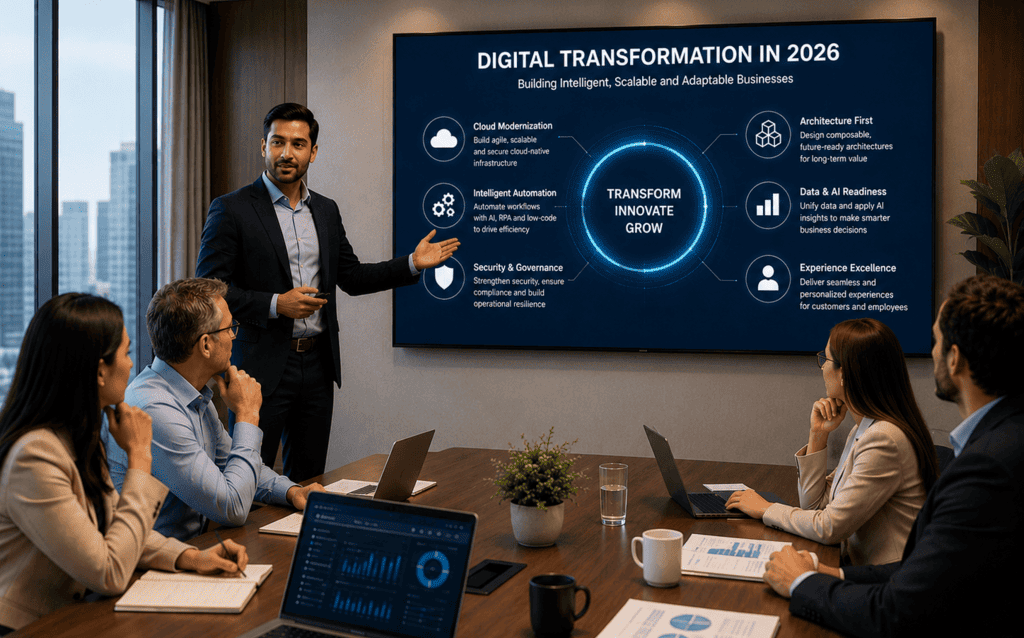
As a result, transformation initiatives now span multiple business and technology layers simultaneously:
- Business process modernization and workflow optimization
- Cloud-native application development and platform scalability
- Digital experience modernization across customer and employee channels
- Data accessibility and AI readiness
- Intelligent automation and system integration
- Security, governance, and operational resilience
- Modern engineering practices and continuous delivery
Organizations that approach these areas as isolated technology projects often create new silos instead of solving existing complexity.
Modern transformation requires connected thinking across architecture, engineering, operations, and business strategy.
AI Is Reshaping Transformation Priorities
The rapid advancement of AI is fundamentally changing how organizations think about modernization.
Transformation is no longer focused solely on digitizing processes or migrating infrastructure. Businesses are now asking how to make operations more intelligent, adaptive, and automated without creating additional technical debt. This shift is driving demand for:
- AI-enabled workflows and decision support systems
- Intelligent automation across operational processes
- AI-powered customer and employee experiences
- Modern data foundations capable of supporting analytics and AI models
- Scalable cloud-native platforms designed for continuous innovation
Organizations are increasingly recognizing that AI cannot deliver meaningful business value on top of fragmented legacy ecosystems.
Without strong digital foundations, AI initiatives often become disconnected experiments rather than scalable business capabilities.
That is why AI strategy and digital transformation are becoming inseparable in 2026.
Why Architecture Has Become Critical
One of the most common reasons transformation initiatives struggle is the absence of strong architectural direction.
Many organizations prioritize frontend modernization while leaving underlying systems, integrations, and operational dependencies untouched. The result is often increased complexity, duplicated functionality, rising cloud costs, and expanding technical debt.
A modern interface alone does not create transformation.
Successful organizations are taking an architecture-first approach that focuses on:
- Composable and scalable digital platforms
- Cloud-native engineering practices
- Seamless integrations across systems and data sources
- Upgrade-safe and future-ready architectures
- Operational scalability and maintainability
- Governance, security, and long-term sustainability
This approach allows businesses to modernize incrementally while maintaining flexibility for future innovation.
At Solveloop, we see this shift firsthand across digital transformation initiatives, Liferay-based digital experience platforms, cloud modernization programs, and intelligent automation projects. Organizations that invest in strong digital architecture early are significantly better positioned to scale AI, automation, and modern digital experiences over time.
Experience-Led Transformation Is Becoming Essential
Technology alone no longer defines transformation success.
Modern businesses are increasingly focusing on experience-led transformation — creating digital ecosystems that improve how customers, employees, and partners interact with the organization. This includes:
- Unified digital experiences across platforms and channels
- Faster and more intuitive user interactions
- Personalized content and service delivery
- Mobile-first and accessibility-focused design approaches
- Seamless integration between frontend experiences and backend operations
The most effective digital platforms are no longer built solely around functionality. They are designed around usability, accessibility, performance, and long-term adaptability.
This is especially important as organizations modernize customer portals, enterprise intranets, self-service platforms, and digital commerce experiences.
Continuous Transformation Is the New Standard
The era of one-time transformation roadmaps is ending.
Markets evolve too quickly for organizations to rely on large-scale modernization projects every five to ten years. Businesses now require continuous modernization capabilities built directly into their operating model. This means embracing:
- Iterative product and platform evolution
- Continuous cloud optimization
- Ongoing automation improvements
- Incremental modernization strategies
- Continuous delivery and DevOps practices
- AI-driven operational enhancement over time
The organizations creating long-term competitive advantage are not necessarily the ones transforming the fastest. They are the ones building systems capable of evolving continuously without constant replatforming or disruption.
Final Thoughts
Digital transformation in 2026 is no longer about becoming “digital.” Most organizations have already crossed that threshold.
The real challenge is adaptability.
Businesses must now build technology ecosystems that can evolve continuously, integrate intelligence naturally, scale efficiently, and respond quickly to changing business demands.
Technology remains an important enabler, but long-term success depends on architecture, operational alignment, scalable engineering, and a clear modernization strategy.
The organizations that succeed will not be the ones adopting the most tools. They will be the ones building the strongest digital foundations for continuous evolution.