Supplier portals have been part of enterprise procurement strategies for years.
They provide suppliers with a digital channel to access purchase orders, submit invoices, review documentation, track transactions and communicate with procurement teams.
But while these portals have successfully moved many procurement activities online, suppliers still spend considerable time trying to answer relatively simple questions:
- Has my purchase order been approved?
- Has my invoice been received?
- Why is my invoice still pending?
- When can I expect payment?
- What are the delivery requirements for this order?
- Which documents do I need to submit?
- What does the procurement policy say about invoice discrepancies?
The information required to answer these questions usually already exists within the enterprise.
The challenge is that it exists across different systems, transactions, documents and processes.
SAP may contain the purchase order, goods receipt, invoice and payment information. Procurement policies and supplier guidelines may exist within a content management system or document repository. Contract information may reside somewhere else entirely.
The supplier is left to navigate these systems and understand how the information fits together.
Artificial intelligence creates an opportunity to change this experience.
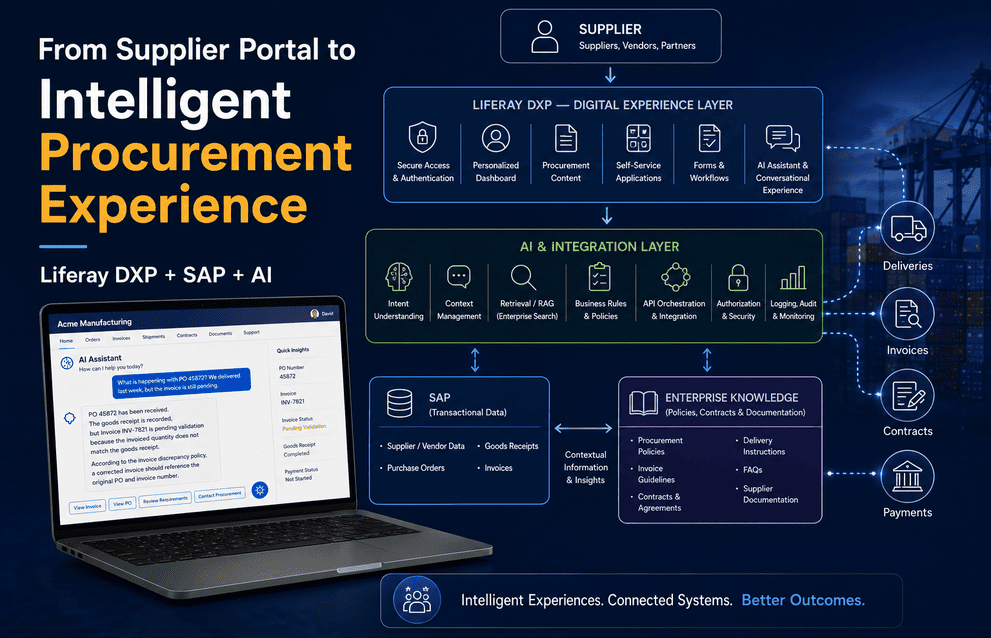
By combining Liferay DXP as the digital experience layer, SAP as the transactional system of record, and AI as an intelligence layer, organizations can evolve traditional supplier portals into intelligent procurement experiences.
The Supplier Portal Has a New Job
- Traditional supplier portals were designed primarily around access to information and transactions.
- Give suppliers access to their purchase orders.
- Allow them to view invoices.
- Publish procurement policies.
- Provide delivery instructions.
- Offer forms and documents.
These capabilities remain important, but expectations around digital experiences are changing.
Users increasingly expect digital platforms to help them find answers rather than simply provide access to information.
Instead of navigating several screens to understand what happened to an invoice, a supplier should be able to ask:
“Why hasn’t invoice INV-7821 been paid?”
The platform should be able to understand the question, retrieve the relevant transaction, identify the current status, consult applicable procurement information and provide a meaningful response.
The next generation of supplier portals will therefore do more than expose procurement information.
They will help suppliers understand that information and determine what to do next.
A Typical Supplier Journey
Consider a manufacturing company, Acme Manufacturing, working with hundreds of suppliers. David is an account manager for one of those suppliers. His company recently delivered an order to Acme, but the corresponding invoice has not progressed to payment.
David logs into Acme’s supplier portal and asks the AI assistant:
“What is happening with PO 45872? We delivered the order last week, but the invoice is still showing as pending.”
The assistant understands David’s request and retrieves the relevant information.
SAP indicates that the purchase order was delivered and the goods receipt has been recorded. However, the associated invoice is currently pending validation because the invoiced quantity does not match the goods receipt.
The AI assistant can then consult Acme’s approved procurement documentation and explain the situation:
PO 45872 has been received, but Invoice INV-7821 is currently pending validation because the invoiced quantity does not match the recorded goods receipt. According to the invoice discrepancy guidelines, a corrected invoice should reference the original purchase order and invoice number.
The portal could then present appropriate actions:
View Invoice | View Purchase Order | Review Invoice Requirements | Contact Procurement
David no longer needs to interpret multiple transaction screens, search through procurement documentation or immediately contact the accounts payable team.
The portal has transformed transactional information into a contextual procurement experience.
What Happens Behind the Experience?
The experience may appear conversational to the supplier, but several enterprise capabilities work together behind the scenes.
Liferay DXP: The Experience Layer
Liferay DXP provides the digital environment through which suppliers interact with the organization.
It can provide capabilities such as:
- Secure supplier authentication
- Personalized supplier dashboards
- Procurement content and documentation
- Self-service applications
- Role-based access
- Forms and workflows
- Integration with enterprise systems
- AI-powered conversational experiences
Rather than replacing existing enterprise applications, Liferay becomes the experience layer through which suppliers access them.
SAP: The Transactional Backbone
SAP continues to serve as the authoritative system for procurement transactions.
Depending on the organization’s SAP landscape and procurement processes, this could include information such as:
- Supplier information
- Purchase orders
- Goods receipts
- Invoice status
- Payment information
- Delivery information
- Procurement transactions
This distinction is important.
The AI assistant should not become another independent source of procurement information. It should retrieve transactional information from the systems responsible for managing that information.
Enterprise Knowledge: The Business Context
Transactional data alone does not always explain what a supplier needs to know.
Knowing that an invoice is “Pending Validation” may be technically correct, but it does not necessarily tell the supplier why it is pending or what they should do next.
The organization may also have:
- Procurement policies
- Invoice submission guidelines
- Delivery instructions
- Supplier onboarding documentation
- Contract documentation
- Frequently asked questions
- Compliance requirements
This knowledge provides the context necessary to interpret the transaction.
AI: The Intelligence and Orchestration Layer
AI connects the supplier’s question with the appropriate enterprise information.
Depending on the use case, this layer can help with:
- Understanding user intent
- Maintaining conversational context
- Retrieving relevant enterprise knowledge
- Calling authorized enterprise APIs
- Combining structured and unstructured information
- Generating contextual responses
- Recommending appropriate next actions
The result is not simply a chatbot sitting on top of the supplier portal.
It becomes an intelligence layer connecting the digital experience with enterprise systems and organizational knowledge.
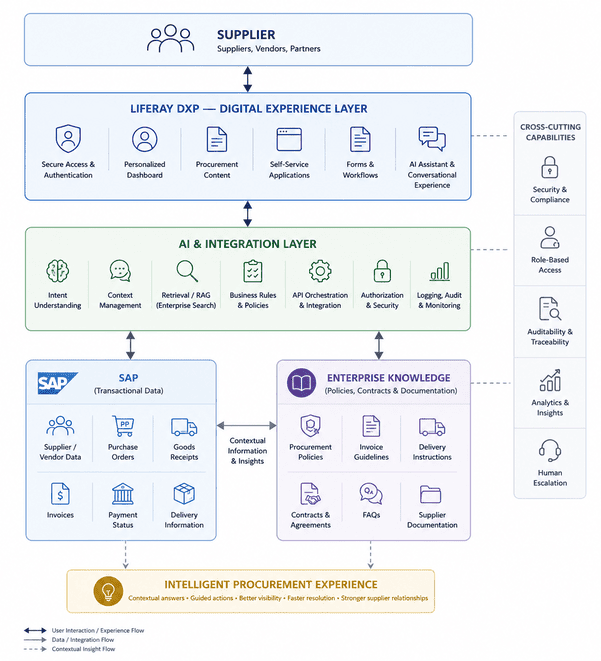
This reinforces an important architectural principle:
Liferay manages the experience. SAP manages the transactions. Enterprise content provides the context. AI connects them intelligently.
AI Connects Transactions With Knowledge
This is where AI can fundamentally improve the supplier experience.
Consider the difference between these two responses.
A traditional portal might display:
Invoice Status: Pending
An intelligent procurement experience could explain:
Your invoice is pending because the invoiced quantity does not match the goods receipt recorded against the purchase order. The invoice discrepancy policy requires the corrected invoice to reference the original PO and invoice number.
The underlying transaction has not changed.
What has changed is the supplier’s ability to understand the transaction in context.
This becomes possible by bringing together two different categories of enterprise information.
Structured Transactional Information
SAP may provide:
Purchase Order → Delivery → Goods Receipt → Invoice → Payment
These transactions tell the organization what happened.
Unstructured Enterprise Knowledge
Procurement documentation may contain:
Policies → Procedures → Guidelines → Contracts → FAQs
This information helps explain what the transaction means and what should happen next.
AI can bring these worlds together.
Instead of forcing suppliers to interpret systems and documentation independently, the digital experience can provide an answer grounded in both the transaction and the organization’s approved knowledge.
From Questions to Procurement Actions
The opportunity goes beyond answering questions.
An intelligent supplier portal can help users move from information to action.
Consider another example.
The supplier asks:
“Why hasn’t my invoice been processed?”
The AI assistant identifies an invoice discrepancy.
It explains the reason, presents the applicable invoice requirements and offers an appropriate next action:
Submit Corrected Invoice
The supplier can then follow the organization’s established workflow to resolve the issue.
This is an important distinction when introducing AI into enterprise processes.
AI should help users understand and navigate business processes — not bypass the systems and controls that govern them.
Sensitive or transactional operations should continue to follow appropriate APIs, workflows, validation rules and authorization mechanisms.
AI improves the experience around the process.
It does not need to replace the process itself.
Making AI Enterprise-Ready
Connecting AI with procurement systems introduces responsibilities that are very different from deploying a general-purpose chatbot.
Several considerations become particularly important.
- Identity and Authorization
A supplier should only be able to access information associated with their organization and authorized accounts. The AI layer must respect the same security boundaries as the underlying applications.
- Grounding
Questions concerning purchase orders, invoices, deliveries and payments should be grounded in authoritative enterprise systems. AI should not guess transactional information.
- Document-Level Permissions
Contracts, pricing agreements and procurement documents may have supplier-specific, regional or business-unit-specific access restrictions. Retrieval mechanisms must respect those permissions.
- Read and Write Operations
There is a significant difference between asking: “What is the status of my invoice?”
and requesting: “Change our banking information.”
Higher-risk operations require stronger validation, authorization and potentially human approval.
- Auditability
Organizations should be able to understand which enterprise systems and documents contributed to an AI-assisted response, particularly where the interaction relates to financial or contractual information.
- Human Escalation
AI will not resolve every procurement question. When confidence is low, information is incomplete or a business exception requires human judgment, the experience should provide a clear path to the appropriate procurement or accounts payable team. Enterprise AI works best when it complements established business controls rather than attempting to eliminate them.
Start With a Focused Procurement Use Case
Organizations do not need to transform the entire supplier experience at once.
A practical approach is to introduce intelligence incrementally.
- Phase 1 — Procurement Knowledge Assistant
- Start with approved procurement policies, supplier FAQs, invoice guidelines and delivery documentation.
- Allow suppliers to ask questions and receive grounded answers from trusted enterprise content.
- Phase 2 — SAP Transaction Lookup
- Introduce secure access to transactional information.
- Suppliers can ask about purchase orders, deliveries, invoices and payment status using natural language.
- Phase 3 — Contextual AI Assistance
- Combine SAP transactions with procurement knowledge.
- Instead of simply reporting an invoice status, the platform can explain the status using the organization’s approved policies and procedures.
- Phase 4 — Guided Supplier Actions
- Allow the AI experience to guide suppliers toward approved actions such as resolving invoice discrepancies, submitting documentation or initiating established workflows.
- Phase 5 — Intelligent Procurement Experience
- Over time, the experience can become increasingly personalized and proactive across supplier onboarding, ordering, delivery, invoicing and payment.
The objective is not to introduce AI everywhere.
It is to identify procurement interactions where AI can reduce friction while maintaining enterprise security and governance.
Beyond the Supplier Portal
Once this architecture is established, the same approach can extend beyond external suppliers.
- Procurement teams could use AI to investigate outstanding transactions or quickly locate procurement policies.
- Accounts payable teams could receive contextual assistance when investigating invoice exceptions.
- Contract managers could find relevant terms and obligations across supplier agreements.
- Internal employees could receive guidance when raising purchase requests or navigating procurement processes.
The underlying pattern remains consistent:
Digital Experience + Enterprise Systems + Enterprise Knowledge + AI
That pattern can support many intelligent enterprise experiences beyond procurement.
From Supplier Portal to Intelligent Procurement Experience
- Enterprises have spent years digitizing procurement.
- Purchase orders moved online.
- Invoices became electronic.
- Supplier documentation became available through portals.
- Workflows became increasingly automated.
The next opportunity is to make those digital processes easier to understand, more contextual and easier to act upon.
Liferay DXP can provide the digital experience through which suppliers interact with the organization.
SAP can remain the trusted transactional backbone managing procurement information.
Enterprise documentation provides the policies, procedures and contractual context surrounding those transactions.
And AI can connect these capabilities through a new intelligence layer.
The result is not simply an AI chatbot added to a supplier portal.
It is the evolution of the portal itself — from a place where suppliers search for information to an experience that helps them understand what is happening, why it is happening and what they can do next.
That is the shift from a supplier portal to an intelligent procurement experience.
At Solveloop, we bring 18+ years of enterprise architecture experience and deep specialization in Liferay DXP — a combination rare among boutique consultancies — to help organizations connect digital experience platforms, enterprise systems like SAP, and AI into practical, governed solutions.
Because the real opportunity with enterprise AI is not simply giving users another place to ask questions.
It is making the systems they already depend on significantly easier to use.