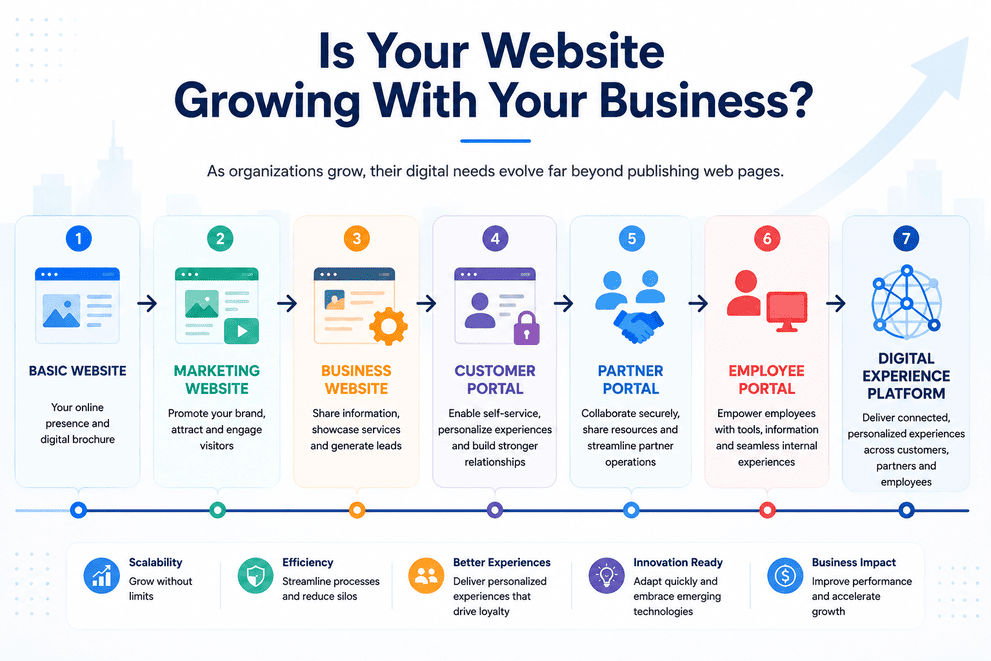
For many organizations, the company website starts as a simple marketing tool—a place to showcase services, publish news, and provide contact information. As the business grows, so do customer expectations, internal processes, and digital initiatives.
What was once a straightforward website gradually becomes responsible for much more. Customers expect self-service. Employees need secure access to information. Partners require collaboration portals. Marketing wants to launch campaigns independently, while IT is expected to integrate multiple business systems and support emerging technologies like AI.
At some point, the challenge is no longer about redesigning the website. It’s about whether the underlying platform can continue to support the business.
Many organizations continue investing in incremental website improvements without realizing they’ve already outgrown it.
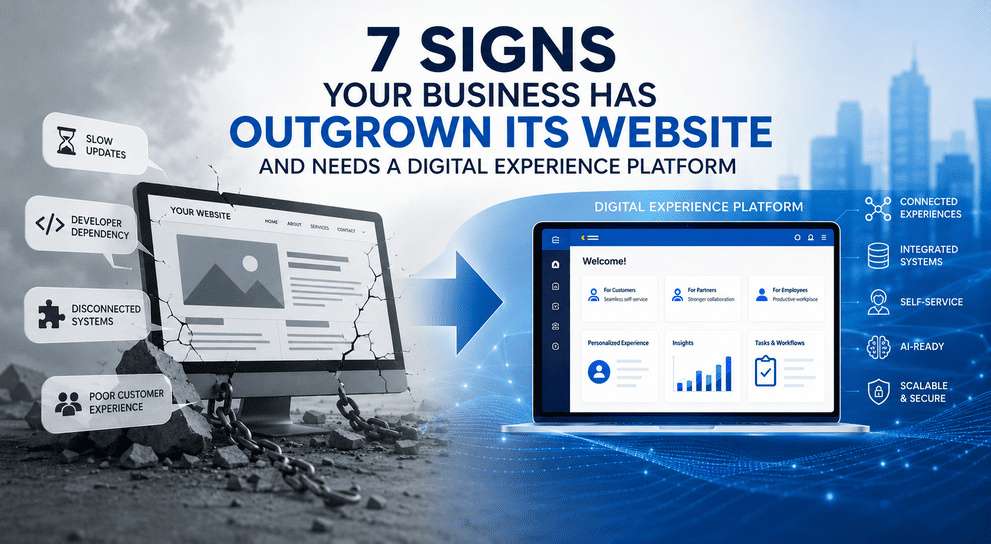
Here are seven common signs that your business may be ready to move beyond a traditional website and adopt a modern Digital Experience Platform (DXP).
Every Website Change Requires Developer Support
One of the earliest warning signs is when even small content updates become technical projects.
Marketing teams wait for developers to update pages. Business users submit tickets for simple content changes. Publishing new landing pages or campaign content takes days instead of hours.
This dependency slows down the entire organization.
A modern digital platform empowers business users through intuitive content management, reusable components, approval workflows, and role-based permissions, allowing teams to move faster without compromising governance.
Instead of IT becoming a bottleneck, business teams become self-sufficient while developers focus on building new capabilities.
Your Digital Content Lives Everywhere
As organizations grow, information naturally spreads across multiple systems.
- Your website contains product information.
- Documents live in SharePoint.
- Customer data resides in a CRM.
- Support articles exist in another platform.
- Marketing assets are stored elsewhere.
- Employees often spend more time searching for information than actually using it.
The result is duplicated content, inconsistent messaging, and higher maintenance costs.
A Digital Experience Platform helps centralize content while connecting to existing business systems, ensuring that users receive consistent, up-to-date information regardless of where it originates.
Customers Expect Self-Service, But Your Website Can’t Deliver It
Customer expectations have changed dramatically.
People no longer want to call or email for every interaction. They expect to:
- Access documents securely
- Submit requests online
- Track applications
- Update personal information
- Download statements
- Complete transactions digitally
If your website primarily provides information but doesn’t enable meaningful interactions, customers will eventually become frustrated.
A Digital Experience Platform transforms static websites into interactive digital experiences where customers can securely access the services they need, anytime and from any device.
Every New Business Requirement Feels Like Starting From Scratch
Adding new capabilities shouldn’t require rebuilding your website.
Yet many organizations find themselves launching separate projects whenever they need to introduce:
- Customer portals
- Knowledge bases
- Event registration
- Online forms
- Authentication
- Search improvements
- Personalized content
Each new requirement often introduces another standalone solution.
Over time, this creates a collection of disconnected applications that are expensive to maintain and difficult to integrate.
A Digital Experience Platform provides a unified foundation that allows new capabilities to be added without reinventing the architecture every time.
Your Business Systems Don’t Work Together
Most organizations already have valuable business systems.
- CRM.
- ERP.
- Identity Management.
- Document Management.
- HR Systems.
- Payment Platforms.
- Marketing Automation.
The problem isn’t the systems themselves.
It’s that they rarely work together seamlessly from the user’s perspective.
Customers shouldn’t need to know which application stores their information. Employees shouldn’t have to log into multiple systems to complete a single task.
A Digital Experience Platform acts as the digital front door, bringing these systems together into one connected experience while preserving existing technology investments.
You’re Investing in AI, But Your Website Isn’t Ready for It
Many organizations have begun experimenting with AI tools like ChatGPT, Microsoft Copilot, or Google Gemini.
These tools can improve productivity, but they’re only part of the picture.
The real business value comes from integrating AI into your digital experiences.
Imagine customers receiving intelligent recommendations based on their activity.
Employees finding answers instantly through AI-powered enterprise search.
Support requests being routed automatically.
Content personalized based on user behaviour.
These capabilities require more than an AI tool—they require a digital platform designed for integrations, APIs, secure access, and scalable architecture.
Without that foundation, AI initiatives often remain isolated experiments rather than becoming part of everyday business operations.
Your Website Is Growing Into Something It Was Never Designed To Be
Perhaps the clearest sign is when your website starts becoming responsible for everything.
It needs to support:
- Multiple business units
- Hundreds of pages
- Multiple brands
- Customer authentication
- Partner collaboration
- Employee resources
- Complex workflows
- System integrations
- Personalized experiences
- AI-powered capabilities
At this stage, the issue isn’t the design.
It’s the platform.
The business has evolved faster than the technology supporting it.
Continuing to add new features to an aging website often increases complexity, technical debt, and long-term costs.
Sometimes the best investment isn’t another redesign—it’s adopting a platform built for the next phase of growth.
So, What Exactly Is a Digital Experience Platform?
A Digital Experience Platform (DXP) is much more than a content management system.
It provides a single platform for delivering connected digital experiences across customers, partners, and employees.
Rather than managing isolated websites and applications, organizations can create a unified digital ecosystem where content, services, workflows, and business systems work together seamlessly.
A modern DXP enables organizations to:
- Deliver personalized digital experiences
- Build secure customer and partner portals
- Integrate existing enterprise applications
- Manage content across multiple channels
- Automate business processes
- Support future AI initiatives
- Scale as business requirements evolve
Instead of repeatedly building new digital solutions, organizations build on a single foundation that continues to grow with the business.
How Solveloop Helps Organizations Build Digital Experiences That Scale
At Solveloop, we often meet organizations that believe they need a new website.
After understanding their business goals, we discover that the real challenge isn’t the website—it’s the digital experience behind it.
Whether you’re modernizing an existing platform, building secure customer portals, integrating enterprise systems, or preparing your digital ecosystem for AI, our approach begins with understanding your business strategy before recommending technology.
We help organizations design digital platforms that are scalable, secure, and aligned with long-term business objectives—allowing technology to become an enabler of growth rather than a constraint.
Final Thoughts
A website remains an essential part of every business.
But as organizations grow, customer expectations evolve, and digital services become increasingly important, a traditional website often reaches its limits.
Recognizing these signs early allows organizations to invest strategically instead of continually patching systems that were never designed for today’s digital demands.
The question isn’t whether your website still works.
The better question is:
Is your current digital platform ready for where your business will be in the next five years?