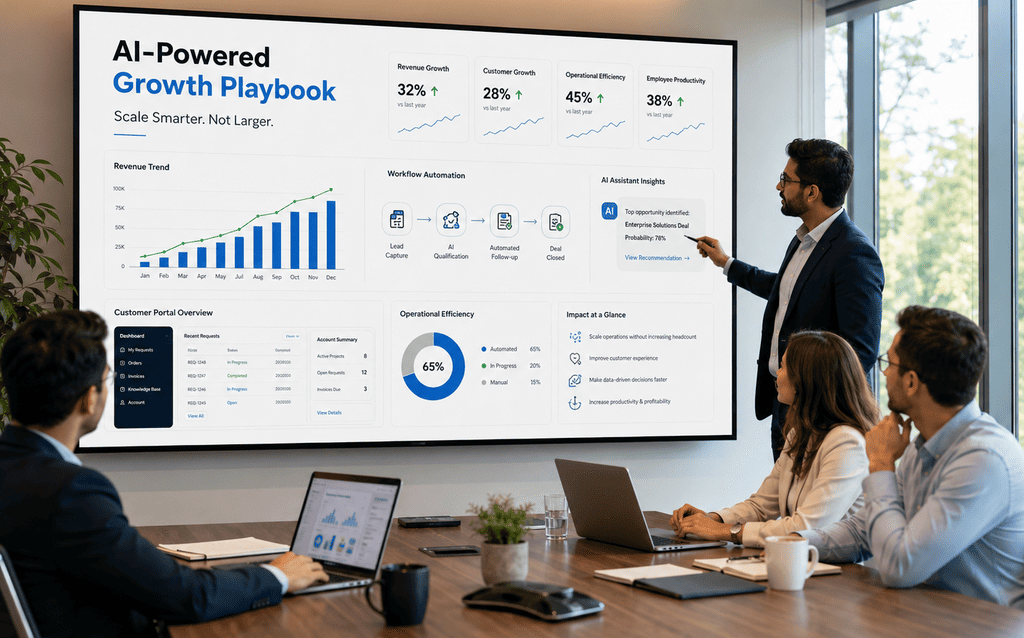
The SMB Growth Dilemma
For many small and medium-sized businesses, growth brings a familiar challenge. More customers often mean more emails to respond to, more service requests to manage, more reports to generate, and more operational complexity to handle.
The traditional approach to growth has been straightforward: hire more people.
Need to support more customers? Add support staff.
Need to process more transactions? Expand the operations team.
Need to generate more sales opportunities? Hire additional sales representatives.
While this approach can work, it also increases operating costs, creates management overhead, and puts pressure on margins. In today’s business environment where talent shortages, rising labour costs, and increasing customer expectations are common simply adding headcount is no longer the most sustainable path to growth.
The good news is that organizations now have access to technologies that were once available only to large enterprises. Artificial Intelligence (AI), intelligent automation, digital experience platforms, and cloud-native solutions are enabling SMBs to scale more efficiently by improving productivity, streamlining operations, and enhancing customer experiences.
The goal is not to replace people. The goal is to enable your existing teams to accomplish more, make better decisions, and focus on higher-value work.
This article explores a practical framework SMBs can use to leverage AI and automation to support business growth without increasing headcount at the same rate.
Why the Traditional Scaling Model No Longer Works
Business growth has historically followed a linear model. As demand increased, organizations hired more employees to manage additional work.
Today, however, several factors are making this model increasingly difficult to sustain.
- Rising Labour Costs
Hiring skilled employees continues to become more expensive across many industries. Beyond salaries, businesses must also account for benefits, onboarding, training, and retention costs.
- Skills Shortages
Finding qualified talent is often more challenging than securing new customers. Many organizations experience delays in growth simply because they cannot fill critical positions quickly enough.
- Increasing Customer Expectations
Customers expect faster responses, self-service capabilities, personalized experiences, and seamless digital interactions. Meeting these expectations solely through manual processes can become costly and inefficient.
- Competitive Pressure
Larger organizations are increasingly investing in AI and automation technologies to improve efficiency. SMBs that fail to modernize risk falling behind competitors that can deliver services faster and at lower operational costs.
The reality is that sustainable growth today requires organizations to improve productivity, not just increase staffing levels.
The AI-Powered Growth Framework
Successful AI adoption is not about deploying the latest technology. It is about identifying areas where employees spend time on repetitive, manual tasks and finding ways to improve efficiency.
The following framework provides a practical approach for SMBs looking to scale intelligently.
Step 1: Eliminate Manual Work
Before introducing sophisticated AI solutions, organizations should identify repetitive activities that consume valuable employee time. Common examples include:
- Manual data entry
- Report generation
- Invoice processing
- Customer data updates
- Document management
- Appointment scheduling
Many businesses are surprised to discover how much time their teams spend performing routine administrative work.
By automating these activities, organizations can free employees to focus on customer engagement, innovation, and strategic initiatives.
The first step toward scalable growth is eliminating work that adds little business value.
Step 2: Automate Core Business Processes
Once manual tasks have been identified, the next opportunity is process automation.
Many SMBs still rely on emails, spreadsheets, and disconnected systems to manage critical workflows. Examples of high-impact automation opportunities include:
- Lead management and qualification
- Customer onboarding
- Service request management
- Approval workflows
- Procurement processes
- Employee onboarding
- Financial reporting
Automating these processes reduces delays, improves consistency, and allows businesses to handle increasing workloads without proportional increases in staffing.
Organizations that automate their core workflows often discover they can support significantly higher transaction volumes using the same operational teams.
Step 3: Empower Employees with AI
One of the most common misconceptions about AI is that it exists to replace employees.
In reality, the most successful AI initiatives focus on enhancing employee productivity.
Think of AI as a digital assistant that helps employees work faster and make better decisions. Examples include:
- AI-generated meeting summaries
- Proposal and document drafting
- Content creation assistance
- Knowledge retrieval and enterprise search
- Customer communication support
- Data analysis and reporting
Instead of spending hours searching for information or preparing routine documents, employees can focus on problem-solving, customer relationships, and strategic activities.
When implemented effectively, AI helps organizations increase output without increasing workload.
Step 4: Create Self-Service Digital Experiences
As organizations grow, customer inquiries and support requests often increase dramatically.
Many businesses respond by expanding support teams.
A more scalable approach is to provide customers, partners, and employees with self-service capabilities. Examples include:
- Customer portals
- Employee portals
- Partner collaboration platforms
- Knowledge bases
- Service request systems
- Account management dashboards
Modern digital experience platforms such as Liferay DXP enable organizations to deliver personalized digital experiences while reducing dependency on manual support processes.
When users can find information, submit requests, track updates, and manage their accounts independently, organizations can serve more customers without continuously increasing support staff.
Step 5: Use Data and AI for Better Decision-Making
Growth creates complexity. As organizations expand, leaders must make decisions based on increasing volumes of data.
AI-powered analytics can help organizations identify trends, predict outcomes, and improve operational visibility. Examples include:
- Sales forecasting
- Customer behavior analysis
- Operational performance monitoring
- Demand prediction
- Resource planning
- Risk identification
Rather than relying solely on historical reports, organizations can use predictive insights to make faster and more informed business decisions.
Better decisions often have a greater impact on growth than adding additional resources.
Five High-Impact AI Use Cases SMBs Can Implement Today
Many SMB leaders understand the potential of AI but struggle to identify practical starting points. The following use cases often deliver measurable value with relatively low implementation complexity.
- AI-Powered Customer Support
AI assistants can answer common customer questions, provide information, and route requests to appropriate teams. This reduces response times while allowing support staff to focus on more complex issues. - Automated Lead Qualification
AI can analyze inbound inquiries, score leads, and prioritize opportunities based on predefined business criteria. Sales teams spend less time on unqualified leads and more time engaging with high-value prospects. - Proposal and Document Generation
AI can help create proposals, project documentation, reports, and customer communications using existing templates and business data. This significantly reduces administrative effort while improving consistency. - Employee Knowledge Assistants
Organizations often struggle with information scattered across emails, documents, and multiple systems. AI-powered knowledge assistants can help employees quickly find relevant information and reduce time spent searching for answers. - Customer Self-Service Portals
Digital portals enable customers to access information, submit requests, track progress, and manage services independently. This improves customer satisfaction while reducing operational workload.
Avoiding Common AI Adoption Pitfalls
While AI presents significant opportunities for SMBs, many organizations struggle to realize meaningful business value because they approach adoption without a clear strategy.
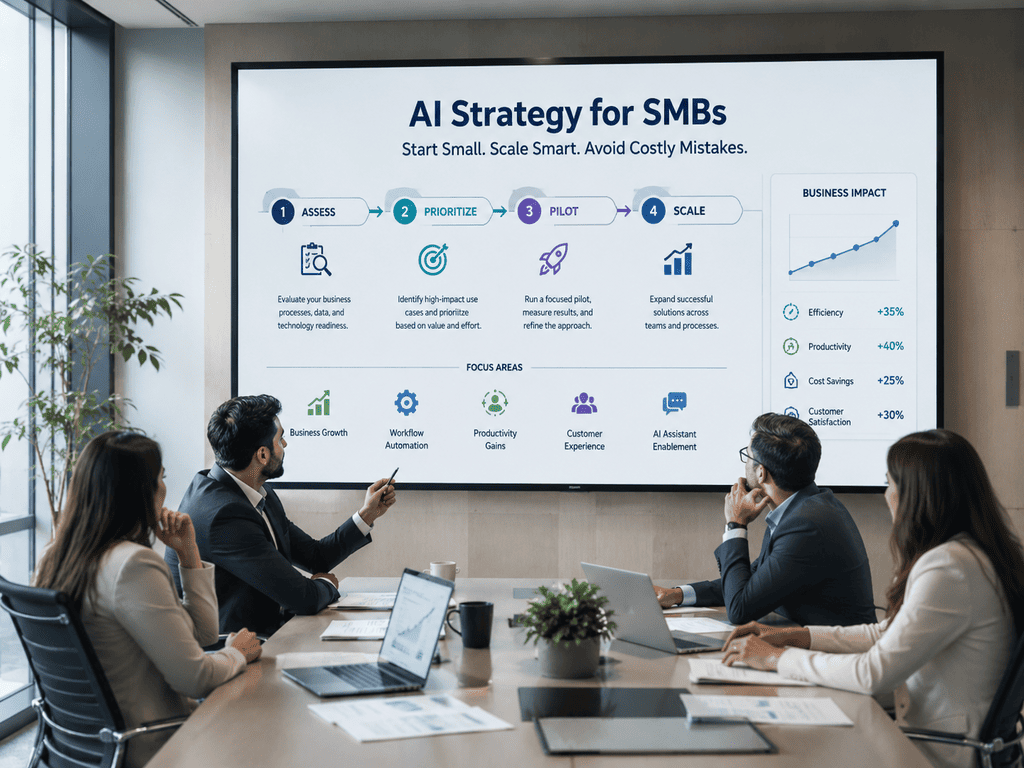
Common challenges include focusing on technology before business outcomes, attempting to automate too many processes at once, overlooking data quality, and failing to establish measurable success criteria. These issues often lead to disappointing results, wasted investments, and skepticism toward future AI initiatives.
The most successful organizations take a more structured approach by aligning AI initiatives with business objectives, prioritizing high-impact use cases, and establishing a roadmap that balances quick wins with long-term transformation goals.
If you’re currently evaluating how AI can support your organization’s growth, we recently explored this topic in detail in our article AI Strategy for SMBs where we discuss the most common AI adoption challenges and practical strategies to avoid them.
Every Business Needs a Different AI Growth Roadmap
One of the biggest misconceptions about AI adoption is that there is a single roadmap that works for every organization.
In reality, every business has different goals, operational challenges, technology landscapes, and growth priorities. A professional services firm may benefit most from AI-assisted knowledge management and proposal generation, while a manufacturing company may achieve greater value through process automation and predictive analytics.
The key is identifying the areas where AI and automation can create measurable business impact within the first 90 days while establishing a foundation for long-term growth.
At Solveloop, we work with organizations to assess their current state, identify high-value opportunities, and develop practical AI adoption roadmaps aligned with their business objectives, operational processes, and technology investments.
Whether your goal is improving productivity, enhancing customer experiences, automating business processes, or enabling data-driven decision-making, a structured roadmap can help ensure your AI initiatives deliver measurable outcomes.
Interested in understanding what an AI-powered growth roadmap could look like for your organization? Contact Solveloop to discuss your business goals and explore practical opportunities for AI and intelligent automation.
How Solveloop Helps SMBs Turn AI Into Business Growth
Many SMB leaders recognize the potential of AI but struggle with where to begin. The challenge is rarely the technology itself. More often, organizations are unsure which opportunities will deliver meaningful business value, how to prioritize investments, or how to integrate AI into their existing operations without disrupting the business.
At Solveloop, we believe successful AI adoption starts with understanding the business before selecting the technology.
Our approach focuses on identifying the operational bottlenecks, repetitive processes, customer experience challenges, and growth constraints that are limiting an organization’s ability to scale efficiently. From there, we work with business and technology stakeholders to assess current capabilities, evaluate opportunities, and define a practical roadmap aligned with business objectives.
Rather than recommending large-scale transformation programs from day one, we typically help organizations identify a small number of high-impact initiatives that can demonstrate measurable value quickly. These may include process automation, AI-assisted employee productivity, customer self-service experiences, workflow optimization, or modernizing digital platforms that support growth.
As organizations begin realizing value from these initiatives, we help establish a longer-term strategy that aligns AI, automation, digital experiences, and cloud technologies with broader business goals.
Our objective is simple: help SMBs make informed technology decisions, reduce operational friction, improve productivity, and create a foundation for sustainable growth.
Because every organization is different, we do not believe in pre-packaged AI roadmaps. The most successful AI strategies are built around an organization’s unique business model, operational challenges, customer expectations, and growth ambitions.
Whether you are exploring AI for the first time or looking to expand existing initiatives, the goal is not simply to adopt AI. The goal is to build a smarter, more scalable business.
Conclusion
The organizations that achieve sustainable growth over the next decade will not necessarily be those with the largest teams.
They will be the businesses that successfully combine people, processes, technology, and AI to operate more efficiently and deliver greater value to customers.
For SMBs, AI is no longer a future consideration. It is becoming an essential capability for improving productivity, enhancing customer experiences, and supporting growth in an increasingly competitive market.
The opportunity is not to replace employees. The opportunity is to empower them.
By taking a strategic and incremental approach to AI adoption, SMBs can scale their operations, improve efficiency, and position themselves for long-term success—without growing headcount at the same pace as revenue.