Introduction
For decades, one of the biggest challenges facing small and medium-sized businesses (SMBs) has been competing with larger organizations that have significantly greater resources.
Large enterprises often have dedicated marketing teams, business analysts, software developers, customer service departments, technical writers, and IT specialists—all working together to improve operations and deliver better customer experiences. In contrast, many SMBs rely on lean teams where employees wear multiple hats and every hour of work counts.
Yet customer expectations have never been higher. Whether purchasing a product, requesting support, or interacting with a company’s website, customers expect the same level of responsiveness, personalization, and professionalism regardless of business size.
This is where Generative AI is changing the landscape.
Rather than replacing employees, Generative AI is enabling smaller businesses to accomplish more with the teams they already have. Tasks that once required multiple specialists can now be completed more efficiently, allowing organizations to focus their time on innovation, customer relationships, and strategic growth.
The result is not simply increased productivity—it is a significant shift in how SMBs can compete against much larger organizations.
The Competitive Gap Is Shrinking
Historically, larger businesses enjoyed advantages that were difficult for smaller organizations to overcome.
They could afford to invest in specialized departments, expensive software platforms, consulting firms, and large technology initiatives. They often launched marketing campaigns faster, produced more content, responded to customers more quickly, and analyzed business data at a much greater scale.
Many SMBs simply accepted these limitations as part of doing business.
Today, that gap is beginning to shrink.
Generative AI provides organizations with capabilities that were previously available only to enterprises with substantial budgets. A single employee supported by AI can now complete work that previously required several people across different departments.
Consider a growing business with a small team of ten employees. The owner might also manage sales, oversee operations, review marketing content, and respond to customer enquiries. Introducing Generative AI doesn’t eliminate these responsibilities—it helps reduce the time required to complete them.
This enables business leaders to spend more time making strategic decisions instead of constantly managing routine work.
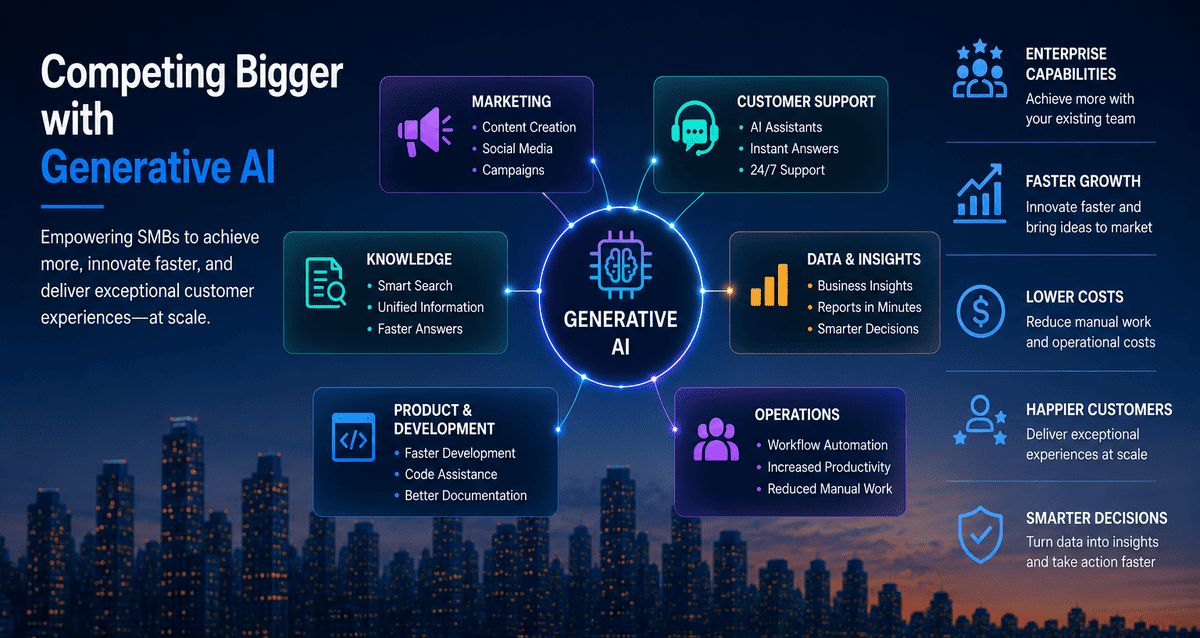
Five Ways Generative AI Levels the Playing Field
1. Marketing Like a Much Larger Company
Marketing is often one of the first areas where SMBs feel resource constraints.
Producing blog articles, social media content, newsletters, email campaigns, landing pages, product descriptions, and search engine optimized website content requires considerable time and expertise.
Many businesses struggle to maintain a consistent online presence because creating quality content competes with day-to-day operational priorities.
Generative AI significantly accelerates this process.
Marketing teams can develop first drafts more quickly, generate campaign ideas, refine messaging for different audiences, and create personalized communications at scale.
Importantly, AI should not replace human creativity. Instead, it provides a strong starting point that allows teams to focus on refining messaging, ensuring accuracy, and delivering content that reflects their brand and expertise.
For SMBs, this means maintaining a consistent marketing presence without dramatically increasing headcount or agency costs.
2. Deliver Better Customer Experiences
Customers increasingly expect immediate responses.
Whether they are looking for product information, requesting support, or searching for documentation, delays often translate into lost opportunities.
Many smaller organizations cannot justify building large customer support teams that operate around the clock.
Generative AI helps bridge this gap through intelligent customer assistants, AI-powered knowledge bases, self-service portals, and automated support experiences.
Rather than waiting for someone to respond to common enquiries, customers can receive accurate answers instantly while employees focus on more complex requests that require human expertise.
Combined with modern digital experience platforms, AI can provide customers with faster, more personalized interactions while reducing operational workload.
The result is improved customer satisfaction without significantly increasing support costs.
3. Unlock Knowledge Hidden Across the Business
Every organization possesses valuable knowledge.
Unfortunately, much of it remains scattered across emails, documents, spreadsheets, internal portals, shared drives, meeting notes, and messaging platforms.
Employees often spend valuable time searching for information instead of applying it.
Generative AI enables organizations to transform these disconnected information sources into searchable knowledge that employees can access using natural language.
Instead of searching through multiple folders or asking colleagues where a document is stored, employees can simply ask a question and receive relevant answers within seconds.
This reduces duplicated effort, shortens onboarding time for new employees, and allows teams to make faster, more informed decisions.
For many SMBs, this represents one of the highest-return AI investments because it improves productivity across the entire organization rather than within a single department.
4. Accelerate Product and Service Delivery
Innovation has traditionally favoured organizations with larger development teams.
Writing requirements, documenting processes, designing user experiences, creating technical documentation, developing software, and testing applications all require significant effort.
Generative AI helps accelerate many of these activities.
Development teams can use AI to generate documentation, review code, prepare technical specifications, create test scenarios, summarize meetings, and assist with repetitive development tasks.
Business analysts can produce better requirements more quickly.
Project managers can generate status reports and meeting summaries.
Designers can rapidly explore new concepts before moving into detailed design.
Rather than replacing experienced professionals, AI allows them to focus more of their time on solving business problems and delivering value.
For organizations developing digital products or modernizing existing applications, these efficiencies can significantly reduce delivery timelines.
5. Make Better Business Decisions Faster
Business leaders rely on information to make informed decisions.
Unfortunately, collecting, organizing, and interpreting that information often takes longer than expected.
Sales reports, financial data, customer feedback, project updates, and operational metrics are frequently stored in different systems, making it difficult to obtain a complete picture.
Generative AI can summarize large volumes of information, identify trends, highlight anomalies, and generate executive-level insights in minutes rather than days.
Instead of spending hours preparing reports, leadership teams can spend more time discussing actions that improve business performance.
Faster access to meaningful insights enables SMBs to respond more quickly to changing customer expectations and market conditions.
Where SMBs Often Get It Wrong
Despite the excitement surrounding Generative AI, many organizations struggle to realize meaningful business value.
A common mistake is approaching AI as a technology initiative rather than a business initiative.
Organizations often begin by purchasing AI tools without first identifying the business problems they are trying to solve.
Others implement isolated solutions across different departments, resulting in disconnected workflows, inconsistent governance, and duplicated effort.
Some expect AI to replace experienced employees entirely, overlooking the importance of human judgment, industry expertise, and organizational knowledge.
Successful AI adoption begins with clearly defined business objectives.
Questions such as improving customer service, reducing manual work, accelerating product delivery, or increasing employee productivity should drive technology decisions—not the other way around.
Organizations that treat AI as part of a broader digital transformation strategy consistently achieve better outcomes than those pursuing isolated experiments.
AI Doesn’t Replace Experience—It Amplifies It
One of the biggest misconceptions surrounding Generative AI is that it exists to replace people.
In reality, its greatest value lies in amplifying human expertise.
An experienced consultant can analyze information more quickly.
A marketer can produce more personalized campaigns.
A software engineer can spend less time writing repetitive code and more time solving complex technical challenges.
A customer service representative can resolve issues faster with AI-assisted knowledge.
Business leaders can make decisions supported by better insights.
AI becomes most valuable when combined with skilled professionals who understand their customers, industry, and business processes.
Technology alone rarely creates competitive advantage.
People using technology effectively do.
Real Opportunities for SMBs Today
Many organizations assume AI requires major transformation initiatives before delivering value.
In practice, numerous opportunities can be implemented incrementally. Some of the most practical applications include:
- AI-powered customer support assistants
- Intelligent internal knowledge search
- Proposal and document generation
- Marketing content creation
- Meeting summarization
- Sales support assistants
- Employee onboarding assistants
- Workflow automation
- Product documentation generation
- Business reporting and executive summaries
These initiatives typically complement existing systems rather than replacing them, allowing organizations to realize value while minimizing disruption.
Building AI Into Business Strategy—Not Around It
As Generative AI continues to evolve, the businesses achieving the greatest success are not necessarily those adopting the most AI tools.
They are the organizations integrating AI thoughtfully into their existing operations, customer experiences, and digital platforms.
Rather than viewing AI as a standalone technology, they treat it as another capability that strengthens business processes, empowers employees, and improves customer outcomes.
At Solveloop, this philosophy shapes how we work with clients.
Every engagement begins with understanding business objectives before selecting technologies. Whether implementing intelligent automation, modern digital experiences, cloud-native applications, or Generative AI solutions, the focus remains on creating measurable business value that supports long-term growth.
Technology should always serve the business strategy—not define it.
Conclusion
Large enterprises will likely continue to have larger budgets, bigger teams, and greater resources.
What they no longer have is an automatic competitive advantage.
Generative AI is enabling SMBs to operate with greater speed, deliver better customer experiences, and make smarter decisions without dramatically increasing headcount.
The organizations that will lead over the next decade will not simply be those investing in AI—they will be the ones integrating it strategically across their business while continuing to invest in the expertise of their people.
For SMBs willing to embrace this shift, Generative AI represents more than another technology trend.
It represents one of the greatest opportunities in decades to compete on a more level playing field.